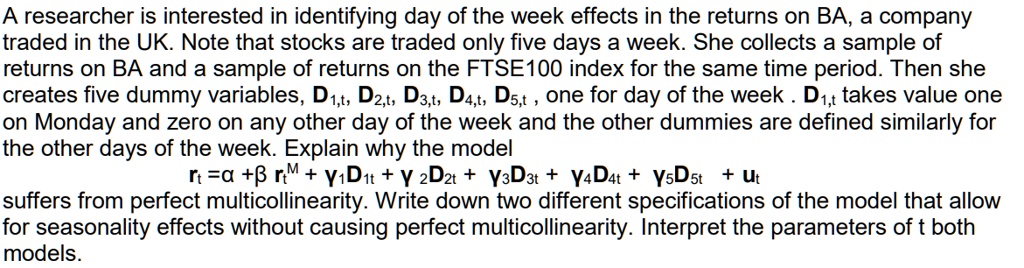
A researcher is interested in identifying day of the week effects in the returns on BA, a company traded in the UK. Note that stocks are traded only five days a week. She collects a sample of returns on BA and a sample of returns on the FTSE100 index for the same time period. Then she creates five dummy variables, $D_{1,t}$, $D_{2,t}$, $D_{3,t}$, $D_{4,t}$, $D_{5,t}$, one for day of the week. $D_{1,t}$ takes value one on Monday and zero on any other day of the week and the other dummies are defined similarly for the other days of the week. Explain why the model
$r_t = \alpha + \beta r_t^M + \gamma_1 D_{1t} + \gamma_2 D_{2t} + \gamma_3 D_{3t} + \gamma_4 D_{4t} + \gamma_5 D_{5t} + u_t$
suffers from perfect multicollinearity. Write down two different specifications of the model that allow for seasonality effects without causing perfect multicollinearity. Interpret the parameters of t both models.