Can someone please show me how to solve this in Python? Comments to please.
Nearest polygonal number
def nearest_polygonal_number(n, s):
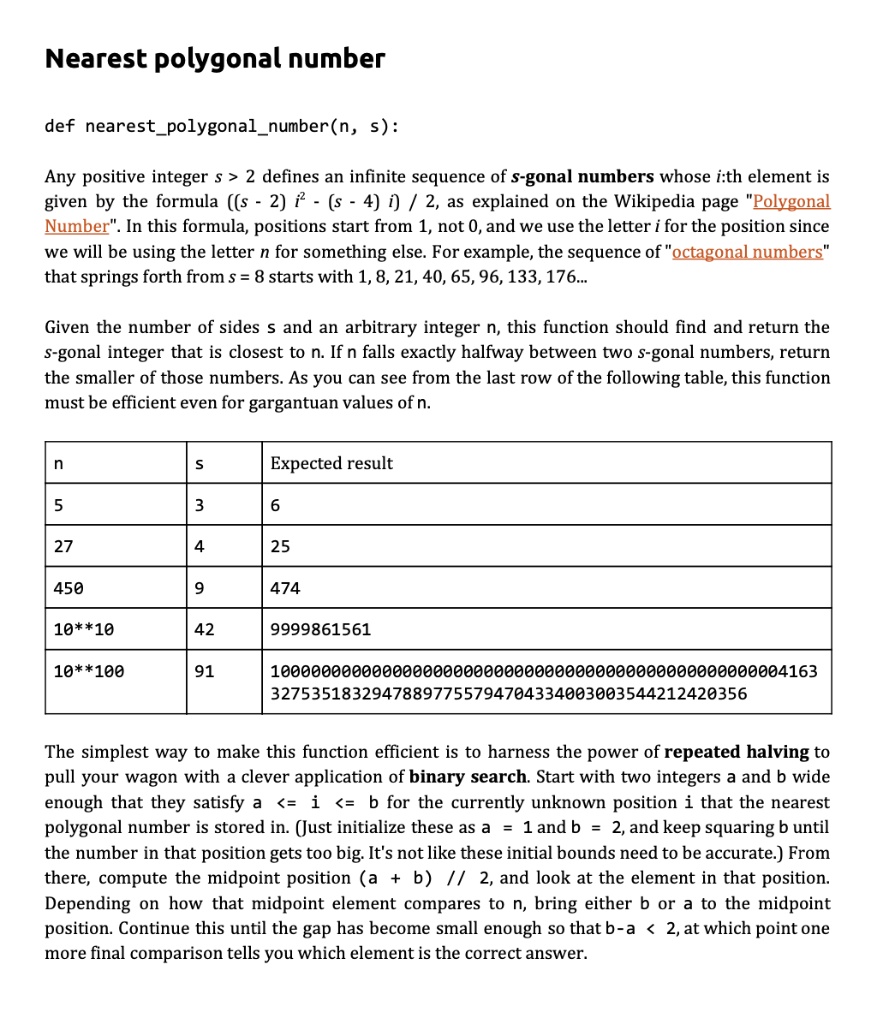
Any positive integer s > 2 defines an infinite sequence of s-gonal numbers whose i-th element is given by the formula (s-2)*(i-1)^2 - (s-4)*(i-1). In this formula, positions start from 1, not 0, and we use the letter i for the position since we will be using the letter n for something else. For example, the sequence of "octagonal numbers" that springs forth from s = 8 starts with 1, 8, 21, 40, 65, 96, 133, 176...
Given the number of sides s and an arbitrary integer n, this function should find and return the s-gonal integer that is closest to n. If n falls exactly halfway between two s-gonal numbers, return the smaller of those numbers. As you can see from the last row of the following table, this function must be efficient even for gargantuan values of n.
n s Expected result
5 3 6
27 4 25
450 9 474
10**10 42 9999861561
10**100 91 100000000000000000000000000000000000000000000000004163
32753518329478897755794704334003003544212420356
The simplest way to make this function efficient is to harness the power of repeated halving to pull your wagon with a clever application of binary search. Start with two integers a and b wide enough that they satisfy a <= i <= b for the currently unknown position i that the nearest polygonal number is stored in. (Just initialize these as a = 1 and b = 2, and keep squaring b until the number in that position gets too big. It's not like these initial bounds need to be accurate.) From there, compute the midpoint position (a + b) // 2, and look at the element in that position. Depending on how that midpoint element compares to n, bring either b or a to the midpoint position. Continue this until the gap has become small enough so that b-a < 2, at which point one more final comparison tells you which element is the correct answer.