Ace - AI Tutor
Ask Our Educators
Textbooks
My Library
Flashcards
Scribe - AI Notes
Notes & Exams
Download App
melissa mel-ndez

melissa m.

Divider

Questions asked

BEST MATCH

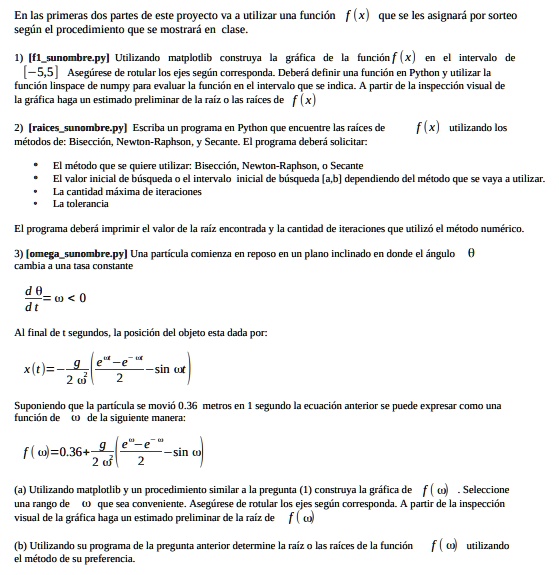
En las primeras dos partes de este proyecto va a utilizar una función $f(x)$ que se les asignará por sorteo según el procedimiento que se mostrará en clase. 1) [f1_sunombre.py] Utilizando matplotlib construya la gráfica de la función $f(x)$ en el intervalo de [-5,5] Asegúrese de rotular los ejes según corresponda. Deberá definir una función en Python y utilizar la función linspace de numpy para evaluar la función en el intervalo que se indica. A partir de la inspección visual de la gráfica haga un estimado preliminar de la raíz o las raíces de $f(x)$ 2) [raices_sunombre.py] Escriba un programa en Python que encuentre las raíces de $f(x)$ utilizando los métodos de: Bisección, Newton-Raphson, y Secante. El programa deberá solicitar: * El método que se quiere utilizar: Bisección, Newton-Raphson, o Secante * El valor inicial de búsqueda o el intervalo inicial de búsqueda [a,b] dependiendo del método que se vaya a utilizar. * La cantidad máxima de iteraciones * La tolerancia El programa deberá imprimir el valor de la raíz encontrada y la cantidad de iteraciones que utilizó el método numérico. 3) [omega_sunombre.py] Una partícula comienza en reposo en un plano inclinado en donde el ángulo $\theta$ cambia a una tasa constante $\frac{d\theta}{dt} = \omega < 0$ Al final de t segundos, la posición del objeto esta dada por: $x(t) = -\frac{g}{2\omega^2}(\frac{e^{\omega t} - e^{-\omega t}}{2} - \sin{\omega t})$ Suponiendo que la partícula se movió 0.36 metros en 1 segundo la ecuación anterior se puede expresar como una función de $\omega$ de la siguiente manera: $f(\omega) = 0.36 + \frac{g}{2\omega^2}(\frac{e^{\omega} - e^{-\omega}}{2} - \sin{\omega})$ (a) Utilizando matplotlib y un procedimiento similar a la pregunta (1) construya la gráfica de $f(\omega)$. Seleccione una rango de $\omega$ que sea conveniente. Asegúrese de rotular los ejes según corresponda. A partir de la inspección visual de la gráfica haga un estimado preliminar de la raíz de $f(\omega)$ (b) Utilizando su programa de la pregunta anterior determine la raíz o las raíces de la función $f(\omega)$ utilizando el método de su preferencia.
View Answer
divider
BEST MATCH

A size-exclusion column is found to have a total volume of 37.9mL and an excluded volume of 12.0mL. A polymer sample was found to have a retention volume of 25.6mL on this column. Calculate Kav for this sample.

View Answer
divider
BEST MATCH

14. (16 pts) The Michaelis-Menten plot below represents data for the enzyme wheat germ acid phosphatase: (A) Draw a Lineweaver-Burk plot from this data (B) Add a line to your plot representing a mixed non-competitive inhibitor (C) Where do mixed-noncompetitive inhibitors bind to the enzyme, and how do they affect $K_m$ and $V_{max}$? (D) Add a line to your Lineweaver-Burk plot to represent a competitive inhibitor. Do you think that the competitive inhibitor would bind more tightly to the enzyme than the substrate? Why or why not?

View Answer
divider
BEST MATCH

Name/explain types of growth and waviness in relation to both bacterial growth pattern \& pigment production in a slant.

View Answer
divider
BEST MATCH

Find the area of the region bounded by the graphs of the equations. Use a graphing utility to verify your result. (Round yo y = \frac{x^2 + 9}{x}, x = 1, x = 6, y = 0

View Answer
divider
BEST MATCH

Which of the following is not an aspect of a successful website? - Generate traffic - Create captivating design - Drive conversion - Maximize revenue

View Answer
divider
BEST MATCH

Which of the following best describes an eccentric contraction? A. Contraction of a synergist muscle B. Controlling the speed of a movement C. Muscle shortening D. Contraction of an agonist muscle

View Answer
divider
BEST MATCH

Question 20 Consider the space curve \(\vec{r}(t) = \langle 2\sqrt{2}\cos(-3t), 3\sin(-3t), \cos(-3t)\rangle\). a. Find the arc length function for \(\vec{r}(t)\). \(s(t) = \) b. Find the arc length parameterization for \(\vec{r}(t)\). \(\vec{r}(s) = \langle \underline{\qquad}, \underline{\qquad}, \underline{\qquad}\rangle\).

View Answer
divider
BEST MATCH

Problem#2 A graphite cuboid of mass m = 1.875 kg is initially at room temperature 25°C and heated with a heating source q = 1 kW as shown in Figure 2. The dimensions are of the cuboid 10cm×15cm×5cm and the heat transfer coefficient h = 2130 W/m².k. Assuming the temperature of the cuboid is going to be homogenous at all times, do the following: a) Derive the equation of motion for the system. b) Find the temperature of the cuboid as a function of time. c) Find the value of $C_p$ if the temperature of cuboid after 10 seconds is 30°C. d) Find the time constant of the system and estimate the steady state time. e) Find the steady state temperature of the cuboid.

View Answer
divider
BEST MATCH

Write the given vector in terms of i and j. 𝘂 = -8i + 2j

View Answer
divider