Ace - AI Tutor
Ask Our Educators
Textbooks
My Library
Flashcards
Scribe - AI Notes
Notes & Exams
Download App
Melvin

Melvin

Divider

Questions asked

ANSWERED

Supratim Pal verified

Numerade educator

A solenoid with 485 turns has a length of 7.00 cm and a cross-sectional area of 3.30 x 10^-3 m^2. Find the solenoid's inductance and the average emf around the solenoid if the current changes from +2.50 A to -2.50 A in 5.33 x 10^-3 s. (a) the solenoid's inductance (in H) (b) the average emf around the solenoid (in V)

View Answer
divider
ANSWERED

Ivan Kochetkov verified

Numerade educator

Electrons and protons travel from the Sun to the Earth at a typical velocity of 4.08 x 10^5 m/s in the positive x-direction. Thousands of miles from Earth, they interact with Earth's magnetic field of magnitude 2.93 x 10^-8 T in the positive z direction. Find the magnitude and direction of the magnetic force on a proton. Find the magnitude and direction of the magnetic force on an electron. HINT (a) magnitude of the magnetic force on a proton (in N) N (b) direction of the magnetic force on a proton +x-direction -x-direction +y-direction -y direction +z-direction -z-direction (c) magnitude of the magnetic force on an electron (in N) N (d) direction of the magnetic force on an electron +x-direction -x direction +y direction -y-direction +z-direction -z-direction

View Answer
divider
ANSWERED

Eduard Sanchez verified

Numerade educator

A solenoid with 485 turns has a length of 7.00 cm and a cross-sectional area of 3.30 x 10^-9 m^2. Find the solenoid's inductance and the average emf around the solenoid if the current changes from +2.50 A to -2.50 A in 5.33 x 10^-3 s. (a) the solenoid's inductance (in H) (b) the average emf around the solenoid (in V)

View Answer
divider
ANSWERED

Ivan Kochetkov verified

Numerade educator

A solenoid with 485 turns has a length of 8.00 cm and a cross-sectional area of 2.50 x 10^-3 m^2. Find the solenoid's inductance and the average emf around the solenoid if the current changes from +3.50 A to -3.50 A in 5.33 x 10^-3 s. (a) the solenoid's inductance (in H) (b) the average emf around the solenoid (in V)

View Answer
divider
ANSWERED

Ankur S verified

Numerade educator

Inductive charging is used to wirelessly charge electronic devices ranging from toothbrushes to cell phones. Suppose the base unit of an inductive charger produces a 1.20 x 10^-3 T magnetic field. Varying this magnetic field magnitude changes the flux through a 16.0-turn circular loop in the device, creating an emf that charges its battery. Suppose the loop area is 2.75 x 10^-4 m^2 and the induced emf has an average magnitude of 5.40 V. Calculate the time required (in s) for the magnetic field to decrease to zero from its maximum value.

View Answer
divider
INSTANT ANSWER

Hopefully this is visible.

View Answer
divider
ANSWERED

Ivan Kochetkov verified

Numerade educator

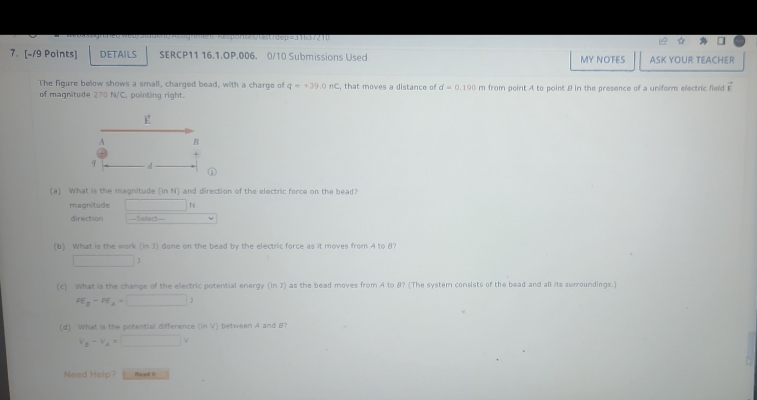
The figure below shows a small, charged bead, with a charge of q = +39.0 nC, that moves a distance of d = 0.190 m from point A to point B in the presence of a uniform electric field E of magnitude 270 N/C, pointing right. (a) What is the magnitude (in N) and direction of the electric force on the bead? magnitude N direction (b) What is the work (in J) done on the bead by the electric force as it moves from A to B? J (c) What is the change of the electric potential energy (in J) as the bead moves from A to B? (The system consists of the bead and all its surroundings.) PE_B - PE_A = (d) What is the potential difference (in V) between A and B? V_B - V_A =
View Answer
divider
ANSWERED

Supratim Pal verified

Numerade educator

This figure shows a sinusoidal wave that is traveling from left to right, in the +x-direction. Assume that it is described by a frequency of 55.2 cycles per second, or hertz (Hz). 7.81 cm 4.90 cm (a) What is the wave's amplitude (in cm)? cm (b) What is the wavelength (in cm)? cm (c) Calculate the wave's period (in s). s (d) Compute the speed of this wave (in m/s). m/s

View Answer
divider
ANSWERED

Ivan Kochetkov verified

Numerade educator

This figure shows a sinusoidal wave that is traveling from left to right, in the +x-direction. Assume that it is described by a frequency of 55.2 cycles per second, or hertz (Hz). 7.81 cm 4.90 cm (a) What is the wave's amplitude (in cm)? cm (b) What is the wavelength (in cm)? cm (c) Calculate the wave's period (in s). s (d) Compute the speed of this wave (in m/s). m/s

View Answer
divider
ANSWERED

Zack A verified

Numerade educator

This figure shows a sinusoidal wave that is traveling from left to right, in the +x-direction. Assume that it is described by a frequency of 17.5 cycles per second, or 8.52 cm 5.30 cm (a) What is the wave's amplitude (in cm)? cm (b) What is the wavelength (in cm)? cm (c) Calculate the wave's period (in s). s (d) Compute the speed of this wave (in m/s). m/s

View Answer
divider