Problem A:
You are tasked with investigating the flow through a large convergent-divergent (con-di) nozzle.
An 'infinite' air reservoir, that you will design by using large compressors, will initially provide
pressures and temperatures of 10atm and 300K, respectively, to feed the nozzle. There are two
locations in the nozzle where (A)/(A^(**))=6, on either side of the throat: one in the convergent nozzle
and one in the divergent section. The flow in the divergent part of the nozzle is designed to be
supersonic.
Start by first figuring out, for both locations (call them State 1 and State 2):
The Mach numbers,
The pressures,
The temperatures,
The speeds,
The speed of sound at both locations, and at the throat.
Sketch (qualitatively is fine) A(x)/(A^(**)),M(x),P(x)/(P_(0)),T(x)/(T_(0)) for the flow from the
stagnation reservoir through both (A)/(A^(**))=6 points, where x is the axial distance through
the nozzle.
Make sure to clearly state all of your assumptions as you carry this through.
Problem B:
Continue your analysis of the nozzle above. The nozzle dumps into a large room, where the back
pressure can be controlled. You set it to 10atm, initially, and gradually reduce it. Plot the air
mass flow rate as a function of back pressure.
Problem C:
Now, your boss asks you to modify that same nozzle so that air at its exit comes out at a Mach
number of 2.5 , tasking you to design a cylindrical wind tunnel test section that will be placed
directly on the nozzle exit plane, with an area of 1m^(2).
Determine:
... the throat diameter that you will use for this;
... the stagnation pressure, assuming that the test section runs at standard atmospheric
pressure;
... the test section temperature, assuming that the reservoir is held at standard
atmospheric temperature.
What potential serious problem do you see with the flow of air in this wind tunnel, if it
were to be used as-is, near Morro Bay, on foggy late spring mornings? What could you
do to remediate that problem?
Problem A:
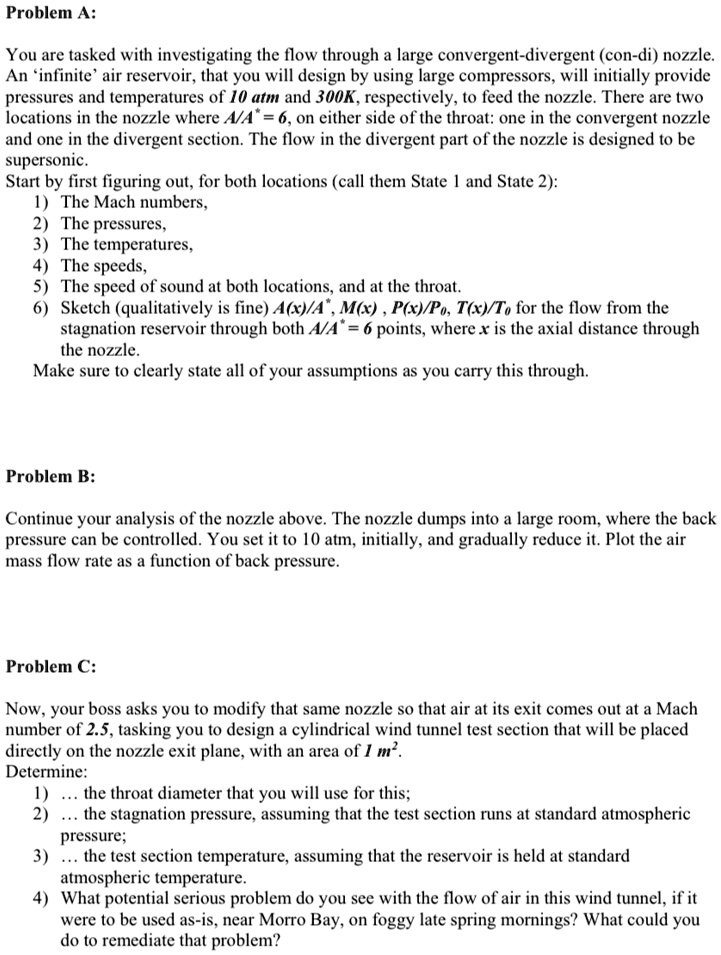
You are tasked with investigating the flow through a large convergent-divergent (con-di) nozzle An infinite' air reservoir, that you will design by using large compressors, will initially provide pressures and temperatures of 10 atm and 300K,respectively,to feed the nozzle.There are two locations in the nozzle where A/A*= 6, on either side of the throat: one in the convergent nozzle and one in the divergent section. The flow in the divergent part of the nozzle is designed to be supersonic. Start by first figuring out, for both locations (call them State 1 and State 2): 1) The Mach numbers, 2) The pressures, 3) The temperatures, 4 The speeds 5) The speed of sound at both locations, and at the throat 6 Sketch qualitatively is fineA(x/A*,M(x,P(x)/Po,T(x/To for the flow from the stagnation reservoir through both A/A = 6 points, where x is the axial distance through the nozzle. Make sure to clearly state all of your assumptions as you carry this through.
Problem B:
Continue your analysis of the nozzle above. The nozzle dumps into a large room,where the back pressure can be controlled. You set it to 10 atm, initially, and gradually reduce it. Plot the air mass flow rate as a function of back pressure.
Problem C:
Now, your boss asks you to modify that same nozzle so that air at its exit comes out at a Mach number of 2.5, tasking you to design a cylindrical wind tunnel test section that will be placed directly on the nozzle exit plane, with an area of I m2. Determine: 1)... the throat diameter that you will use for this 2) ... the stagnation pressure, assuming that the test section runs at standard atmospheric pressure; 3)... the test section temperature, assuming that the reservoir is held at standard atmospheric temperature. 4) What potential serious problem do you see with the flow of air in this wind tunnel, if it were to be used as-is, near Morro Bay, on foggy late spring mornings? What could you do to remediate that problem?