Preliminary Exercise to Lab 2
Lab Section #:
Name: Kaitlyn mankey
It is important for students at your level of education to possess a working knowledge of the
metric system because science uses it. This course, however, does not aim to teach you how to
use the metric system. The following exercise is meant merely to give you an idea of whether
you know the metric system well enough to tackle Lab 2. You should be able to perform the
conversions and arrive at the correct answers to these questions in your mind, i.e., without
using a calculator. If you find that you cannot, then by all means, plug your "knowledge gap"
before coming to lab. Ultimately, your ability to use the metric system correctly may affect
your success in this, and other, courses.
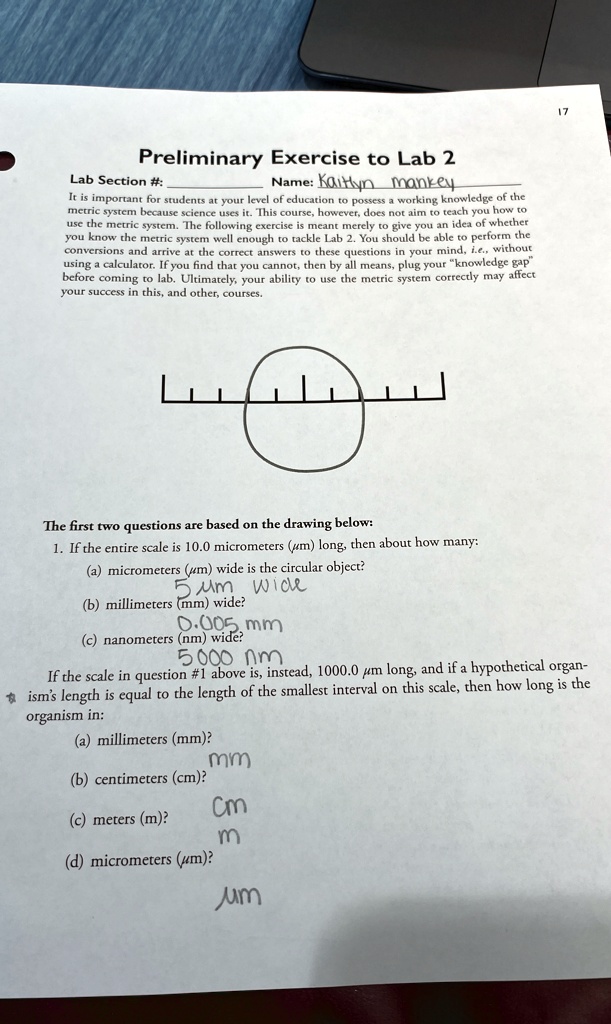
The first two questions are based on the drawing below:
1. If the entire scale is 10.0 micrometers (um) long, then about how many:
(a) micrometers (um) wide is the circular object?
5 um wide
(b) millimeters (mm) wide?
0.005 mm
(c) nanometers (nm) wide?
5000 nm
If the scale in question #1 above is, instead, 1000.0 µm long, and if a hypothetical organ-
ism's length is equal to the length of the smallest interval on this scale, then how long is the
organism in:
(a) millimeters (mm)?
mm
(b) centimeters (cm)?
(c) meters (m)?
Cm
m
(d) micrometers (um)?
um