Ace - AI Tutor
Ask Our Educators
Textbooks
My Library
Flashcards
Scribe - AI Notes
Notes & Exams
Download App
Merve Sude

Merve S.

Divider

Questions asked

INSTANT ANSWER

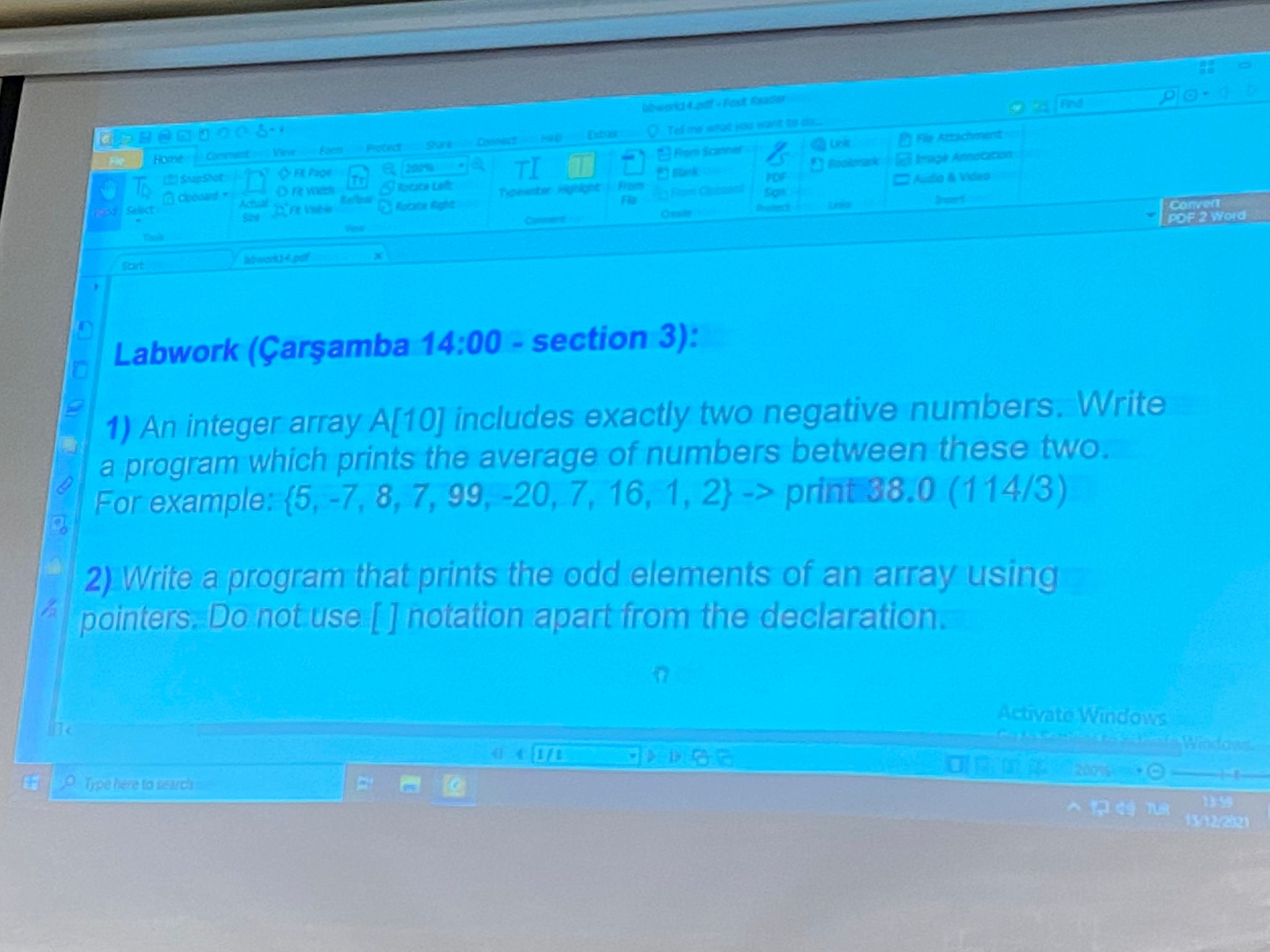
Labwork (Çar?amba 14:00 - section 3): 1) An integer array \( A[10] \) includes exactly two negative numbers. Write a program which prints the average of numbers between these two. For example: \( \{5,-7,8,7,99,-20,7,16,1,2\} \rightarrow \) print \( 38.0(114 / 3) \) 2) Write a program that prints the odd elements of an array using pointers. Do not use [] notation apart from the declaration.
View Answer
divider
INSTANT ANSWER

Labwork (Çar?amba 14:00 - section 3): 1) An integer array \( A[10] \) includes exactly two negative numbers. Write a program which prints the average of numbers between these two. For example: \( \{5,-7,8,7,99,-20,7,16,1,2\} \rightarrow \) print \( 38.0(114 / 3) \) 2) Write a program that prints the odd elements of an array using pointers. Do not use [] notation apart from the declaration.

View Answer
divider
INSTANT ANSWER

1) An integer array \( A[10] \) includes exactly two negative numbers. Write a program which prints the average of numbers between these two. For example: \( \{5,-7,8,7,99,-20,7,16,1,2\} \rightarrow \) print \( 38.0(114 / 3) \) 2) Write a program that prints the odd elements of an array using pointers. Do not use [] notation apart from the declaration.

View Answer
divider
INSTANT ANSWER

(20 points) Let \[ A=\left[\begin{array}{ccc} -9 & -4 & -3 \\ -3 & 3 & -1 \\ 3 & -3 & 1 \\ 9 & 4 & 3 \end{array}\right] \] Find a basis for the image of \( A \) (or, equivalently, for the linear transformation \( T(x)=A x) \).

View Answer
divider
INSTANT ANSWER

(20 points) Let \( f: \mathbb{R}^{3} \rightarrow \mathbb{R}^{2} \) be the linear transformation defined by \[ f(x, y, z)=\left[\begin{array}{c} -3 \\ 5 \end{array}\right] x+\left[\begin{array}{c} -7 \\ 12 \end{array}\right] y+\left[\begin{array}{c} -19 \\ 32 \end{array}\right] z . \] Find bases for the kernel and image of \( f \). vector.

View Answer
divider
INSTANT ANSWER

(20 points) Let \( \vec{b}_{1}=\left[\begin{array}{c}-1 \\ 2\end{array}\right] \) and \( \vec{b}_{2}=\left[\begin{array}{c}3 \\ -7\end{array}\right] \). The set \( B=\left\{\vec{b}_{1}, \vec{b}_{2}\right\} \) is a basis for \( \mathbb{R}^{2} \). Let \( T: \mathbb{R}^{2} \rightarrow \mathbb{R}^{2} \) be a linear transformation such that \( T\left(\vec{b}_{1}\right)=8 \vec{b}_{1}+5 \vec{b}_{2} \) and \( T\left(\vec{b}_{2}\right)=3 \vec{b}_{1}+6 \vec{b}_{2} \). (a) The matrix of \( T \) relative to the basis \( B \) is

View Answer
divider
INSTANT ANSWER

(20 points) The linear tranformation \( L \) defined by \[ L(p(x))=3 p^{\prime}-15 p^{\prime \prime} \] maps \( P_{4} \) into \( P_{3} \). (a) Find the matrix representation of \( L \) with respect to the ordered bases \[ S=\left[\begin{array}{ll} E=\left\{x^{3}, x^{2}, x, 1\right\} \text { and } F=\left\{x^{2}+x+1, x+1,1\right\} & \\ \hline & \end{array}\right] \] (b) Use Part (a) to find the coordinate vectors of \( L(p(x)) \) and \( L(g(x)) \) where \( p(x)=-10 x^{3}-4 x \) and \( g(x)=x^{2}+14 \).

View Answer
divider
INSTANT ANSWER

(20 points) Let \[ A=\left[\begin{array}{ccc} -9 & -4 & -3 \\ -3 & 3 & -1 \\ 3 & -3 & 1 \\ 9 & 4 & 3 \end{array}\right] \] Find a basis for the image of \( A \) (or, equivalently, for the linear transformation \( T(x)=A x) \).

View Answer
divider
INSTANT ANSWER

(20 points) Let \( \mathcal{P}_{n} \) be the vector space of all polynomials of degree \( n \) or less in the variable \( x . \) Let \( D^{2}: \mathcal{P}_{4} \rightarrow \mathcal{P}_{2} \) be the linear transformation that takes a polynomial to its second derivative. That is, \( D^{2}(p(x))=p^{\prime \prime}(x) \) for any polynomial \( p(x) \) of degree 4 or less. A basis for the kernel of \( D^{2} \) is \{ \}. Enter a polynomial or a comma separated list of polynomials. A basis for the image of \( D^{2} \) is \{ \}. Enter a polynomial or a comma separated list of polynomials.

View Answer
divider
INSTANT ANSWER

(20 points) Let \( f: \mathbb{R}^{3} \rightarrow \mathbb{R}^{2} \) be the linear transformation defined by \[ f(x, y, z)=\left[\begin{array}{c} -3 \\ 5 \end{array}\right] x+\left[\begin{array}{c} -7 \\ 12 \end{array}\right] y+\left[\begin{array}{c} -19 \\ 32 \end{array}\right] z . \] Find bases for the kernel and image of \( f \). vector.

View Answer
divider