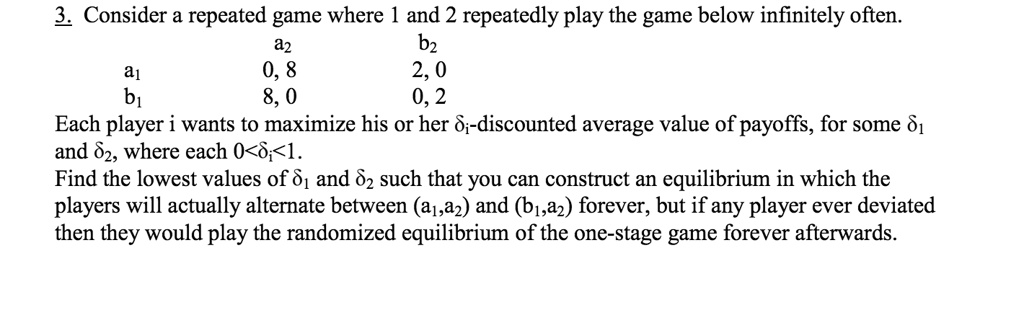
3. Consider a repeated game where 1 and 2 repeatedly play the game below infinitely often.
a1
b1
a2
0, 8
8, 0
b2
2, 0
0, 2
Each player i wants to maximize his or her $\delta_i$-discounted average value of payoffs, for some $\delta_1$
and $\delta_2$, where each $0 < \delta_i < 1$.
Find the lowest values of $\delta_1$ and $\delta_2$ such that you can construct an equilibrium in which the
players will actually alternate between ($a_1, a_2$) and ($b_1, a_2$) forever, but if any player ever deviated
then they would play the randomized equilibrium of the one-stage game forever afterwards.