5. Fiscal policy in the AD-AS model and the multiplier effect
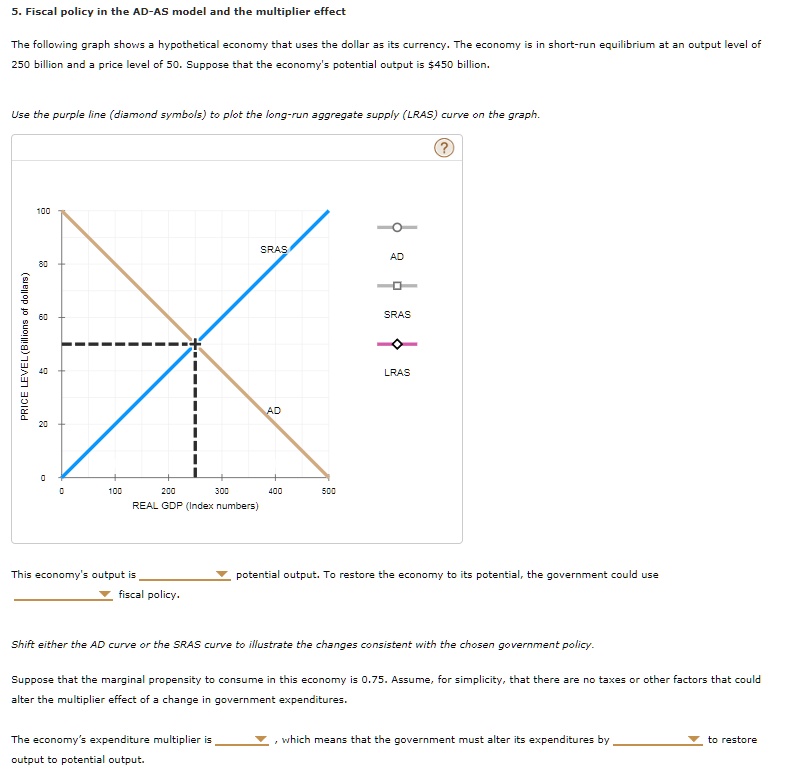
The following graph shows a hypothetical economy that uses the dollar as its currency. The economy is in short-run equilibrium at an output level of
250 billion and a price level of 50. Suppose that the economy's potential output is $450 billion.
Use the purple line (diamond symbols) to plot the long-run aggregate supply (LRAS) curve on the graph.
PRICE LEVEL (Billions of dollars)
100
80
60
40
20
0
0
100
200
300
400
500
REAL GDP (Index numbers)
SRAS
AD
AD
SRAS
LRAS
This economy's output is
potential output. To restore the economy to its potential, the government could use
fical policy.
Shift either the AD curve or the SRAS curve to illustrate the changes consistent with the chosen government policy.
Suppose that the marginal propensity to consume in this economy is 0.75. Assume, for simplicity, that there are no taxes or other factors that could
alter the multiplier effect of a change in government expenditures.
The economy's expenditure multiplier is
, which means that the government must alter its expenditures by
to restore
output to potential output.