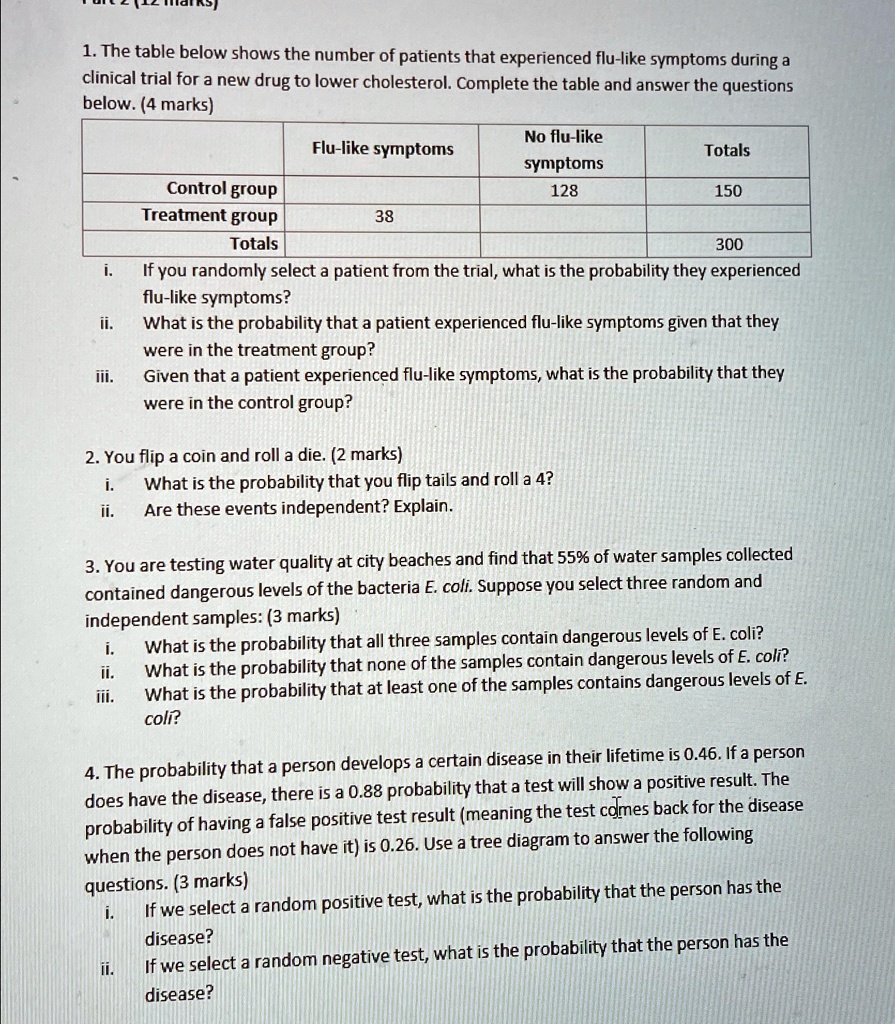
The table below shows the number of patients that experienced flu-like symptoms during a clinical trial for a new drug to lower cholesterol. Complete the table and answer the questions below. (4 marks)
able[[,Flu-like symptoms, able[[No flu-like],[symptoms]],Totals],[Control group,,128,150],[Treatment group,38,,],[Totals,,,300]]
i. If you randomly select a patient from the trial, what is the probability they experienced flu-like symptoms?
ii. What is the probability that a patient experienced flu-like symptoms given that they were in the treatment group?
iii. Given that a patient experienced flu-like symptoms, what is the probability that they were in the control group?
2. You flip a coin and roll a die. (2 marks)
i. What is the probability that you flip tails and roll a 4?
ii. Are these events independent? Explain.
3. You are testing water quality at city beaches and find that 55% of water samples collected contained dangerous levels of the bacteria E. coli. Suppose you select three random and independent samples: (3 marks)
i. What is the probability that all three samples contain dangerous levels of E. coli?
ii. What is the probability that none of the samples contain dangerous levels of E. coli?
iii. What is the probability that at least one of the samples contains dangerous levels of E. coli?
4. The probability that a person develops a certain disease in their lifetime is 0.46 . If a person does have the disease, there is a 0.88 probability that a test will show a positive result. The probability of having a false positive test result (meaning the test colmes back for the disease when the person does not have it) is 0.26 . Use a tree diagram to answer the following questions. (3 marks)
i. If we select a random positive test, what is the probability that the person has the disease?
ii. If we select a random negative test, what is the probability that the person has the disease?
(SVIPUUZT)Z
1.The table below shows the number of patients that experienced flu-like symptoms during a clinical trial for a new drug to lower cholesterol.Complete the table and answer the questions below. (4 marks) No flu-like Flu-like symptoms Totals symptoms Control group 128 150 Treatment group 38 Totals 300 i. If you randomly select a patient from the trial, what is the probability they experienced flu-like symptoms? ii. What is the probability that a patient experienced flu-like symptoms given that they were in the treatment group? ii. Given that a patient experienced flu-like symptoms,what is the probability that they were in the control group?
2.You flip a coin and roll a die.2marks i. What is the probability that you flip tails and roll a 4? 1i. Are these events independent?Explain.
3. You are testing water quality at city beaches and find that 55% of water samples collected contained dangerous levels of the bacteria E. coli. Suppose you select three random and independent samples:(3marks) i. What is the probability that all three samples contain dangerous levels of E. coli? ii. What is the probability that none of the samples contain dangerous levels of E. coli? ii. What is the probability that at least one of the samples contains dangerous levels of E coli? 4. The probability that a person develops a certain disease in their lifetime is 0.46. If a person does have the disease, there is a 0.88 probability that a test will show a positive result. The probability of having a false positive test result (meaning the test comes back for the disease when the person does not have it) is 0.26. Use a tree diagram to answer the following questions.(3 marks) If we select a random positive test, what is the probability that the person has the disease? If we select a random negative test,what is the probability that the person has the ii. disease?