Questions asked
Experimental measurements at 298 K suggest that the Arrhenius equation for the rate constant takes the form:
A nursing instructor asks students the following question: "Into which categories do neoplasms fall?" Select all that apply. Malignant Benign Mass Inflammatory Traumatic
how much heat is gained by nickel when 17.8 g of nickel is warmed from 25.9 Celsius to 76.2
What is the keyword we use to get a specific number of records back instead of all the records?
2. Suppose you constructed 60 confidence intervals - by drawing 60 samples - with confidence level 95%. About how many of them would you expect to be successful? That is, how many would actu- ally contain the parameter that is being estimated? Should you be surprised if 10 of them are successful?
Compute the future value of 2000 compounded annually for 20 years at 7 percent
unil is trying to decide whether he wants to purchase shares in General Motors, Ford, or Honda, all of which are auto manufacturers. Sunil is making a(n) _____________blank decision. Multiple Choice
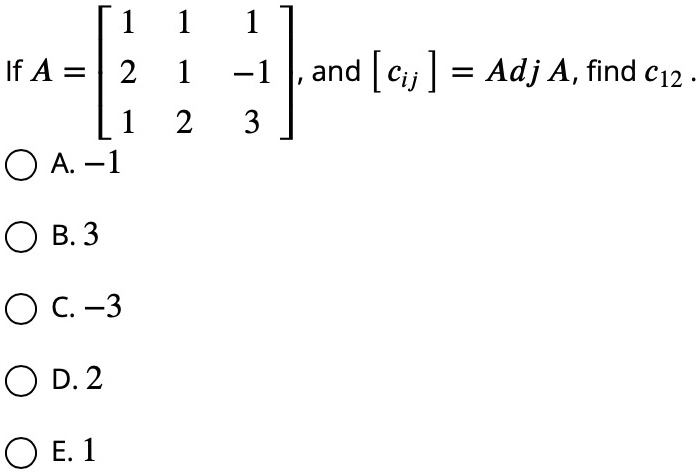
If A=[[1,1,1],[2,1,-1],[1,2,3]], and [c_(ij)]=AdjA, find c_(12). A. -1 B. 3 C. -3 D. 2 E. 1 [1 1 If A = 2 1 2 A.-1 1 -1 Land[ci]= Adj A, find c12 3 B.3 0 C.-3 D.2 E.1
A discrete filter with a low pass response, cutoff 100 Hz, and a sample rate of 10 kHz is required. (a) Design the continuous - time Butterworth filter for these parameters using a normalized 1 rad per sample cutoff. Calculate the transfer function using algebra, and check your answer using the MATLAB code outlined in the text. (b) Scale the Butterworth filter to the desired cutoff and plot the frequency response. (c) Convert the normalized Butterworth filter to a discrete - time one using the bilinear transform. (d) Plot the frequency response and compare to the design specification Please help me with this assignment question by providing the Transfer Function and Matlab implementation of all 4 parts
Experimental Procedure 1. Pour approximately 30 mL of 2.00 x 10?³ M Fe(NO?)? in 1 M HNO? into a small, labeled beaker, and pour approximately 20 mL of KSCN into a second small, labeled beaker. 2. Combine 2.00 x 10?³ M Fe(NO?)? in 1 M HNO?, 2.00 x 10?³ M KSCN, and water in the proportions given for Reaction Mixture 1 in Table 1. Mix thoroughly with a stirring rod. 3. Measure the absorbance of this solution at 447 nm using a SPEC 20 spectrophotometer. Instructions for using the SPEC 20 are provided with the instrument. Follow these instructions carefully. 4. Record the absorbance and the concentration of FeSCN²? using the accompanying graph. Record the letter of the instrument you use in your data table. 5. Repeat Steps 2 through 4 for the other four reaction mixtures. FeSCN²? is not stable for very long; you should take the absorbance of each solution immediately after you make it rather than making all five solutions at once and then taking absorbance readings of each. Table 1. Reaction Mixture Composition Volume of Fe(NO?)? solution (mL) Volume of KSCN solution (mL) Volume of water (mL) 1 2 5.00 5.00 1.00 2.00 4.00 3.00 3 5.00 3.00 2.00 Reaction Mixture 4 5 5.00 5.00 4.00 5.00 1.00 0