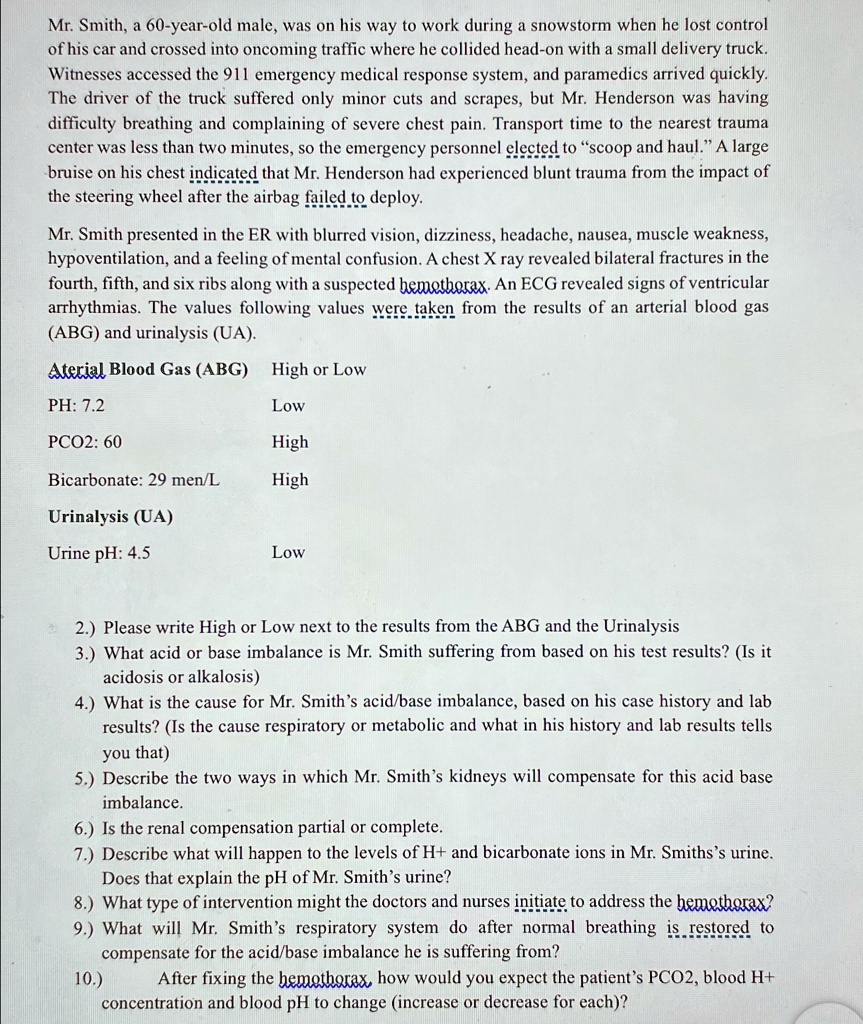
Mr. Smith, a 60-year-old male, was on his way to work during a snowstorm when he lost control of his car and crossed into oncoming traffic where he collided head-on with a small delivery truck. Witnesses accessed the 911 emergency medical response system, and paramedics arrived quickly. The driver of the truck suffered only minor cuts and scrapes, but Mr. Henderson was having difficulty breathing and complaining of severe chest pain. Transport time to the nearest trauma center was less than two minutes, so the emergency personnel elected to "scoop and haul." A large bruise on his chest indicated that Mr. Henderson had experienced blunt trauma from the impact of the steering wheel after the airbag failed to deploy.
Mr. Smith presented in the ER with blurred vision, dizziness, headache, nausea, muscle weakness, hypoventilation, and a feeling of mental confusion. A chest x-ray revealed bilateral fractures in the fourth, fifth, and sixth ribs along with a suspected hemothorax. An ECG revealed signs of ventricular arrhythmias. The values following values were taken from the results of an arterial blood gas (ABG) and urinalysis (UA).
able[[Arterial Blood Gas (ABG), High or Low],[PH: 7.2, Low],[PCO2: 60, High],[Bicarbonate: 29 me(n)/(L), High],[Urinalysis (UA),],[Urine pH: 4.5, Low]]
2.) Please write High or Low next to the results from the ABG and the Urinalysis
3.) What acid or base imbalance is Mr. Smith suffering from based on his test results? (Is it acidosis or alkalosis)
4.) What is the cause for Mr. Smith's acid/base imbalance, based on his case history and lab results? (Is the cause respiratory or metabolic and what in his history and lab results tells you that)
5.) Describe the two ways in which Mr. Smith's kidneys will compensate for this acid-base imbalance.
6.) Is the renal compensation partial or complete.
7.) Describe what will happen to the levels of H+ and bicarbonate ions in Mr. Smith's urine. Does that explain the pH of Mr. Smith's urine?
8.) What type of intervention might the doctors and nurses initiate to address the hemothorax?
9.) What will Mr. Smith's respiratory system do after normal breathing is restored to compensate for the acid/base imbalance he is suffering from?
10.) After fixing the hemothorax, how would you expect the patient's PCO2, blood H+ concentration, and blood pH to change (increase or decrease for each)?