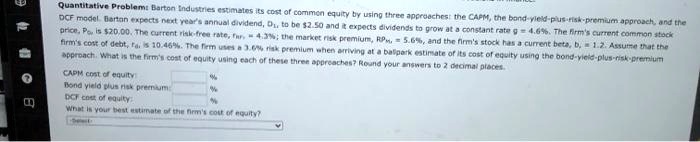
Quantitative Problem: Barton Industries estimates its cost of common equity by using three approaches: the CAPM, the bond-yield-plus-risk-premium approach, and the
DCF model. Barton expects next year's annual dividend, $D_1$, to be $2.50 and it expects dividends to grow at a constant rate $g = 4.6\%$. The firm's current common stock
price, $P_0$, is $20.00. The current risk-free rate, $r_{rf}$, = 4.3%; the market risk premium, $RP_m$, = 5.6%, and the firm's stock has a current beta, $b$, = 1.2. Assume that the
firm's cost of debt, $r_d$, is 10.46%. The firm uses a 3.6% risk premium when arriving at a ballpark estimate of its cost of equity using the bond-yield-plus-risk-premium
approach. What is the firm's cost of equity using each of these three approaches? Round your answers to 2 decimal places.
CAPM cost of equity:
Bond yield plus risk premium:
%
%
DCF cost of equity:
What is your best estimate of the firm's cost of equity?