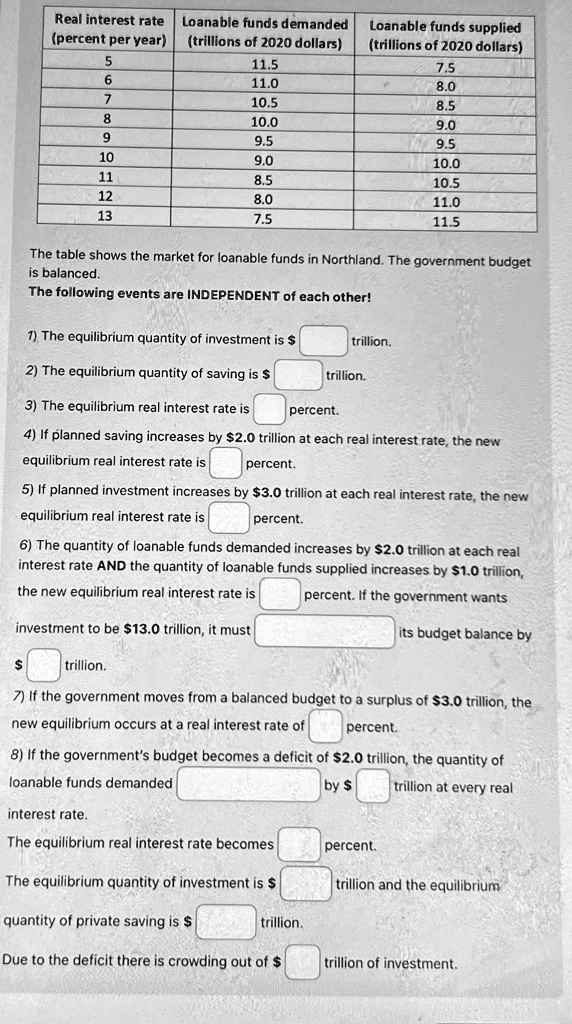
able[[ able[[Real interest rate],[(percent per year)]], able[[Loanable funds demanded],[(trillions of 2020 dollars)]], able[[Loanable funds supplied],[(trillions of 2020 dollars)]]],[5,11.5,7.5],[6,11.0,8.0],[7,10.5,8.5],[8,10.0,9.0],[9,9.5,9.5],[10,9.0,10.0],[11,8.5,10.5],[12,8.0,11.0],[13,7.5,11.5]]
The table shows the market for loanable funds in Northland. The government budget is balanced.
The following events are INDEPENDENT of each other!
The equilibrium quantity of investment is $ trillion.
The equilibrium quantity of saving is $ trillion.
The equilibrium real interest rate is percent.
If planned saving increases by $2.0 trillion at each real interest rate, the new equilibrium real interest rate is percent.
If planned investment increases by $3.0 trillion at each real interest rate, the new equilibrium real interest rate is percent.
The quantity of loanable funds demanded increases by $2.0 trillion at each real interest rate AND the quantity of loanable funds supplied increases by $1.0 trillion, the new equilibrium real interest rate is percent. If the government wants investment to be $13.0 trillion, it must its budget balance by
$ trillion.
If the government moves from a balanced budget to a surplus of $3.0 trillion, the new equilibrium occurs at a real interest rate of percent.
If the government's budget becomes a deficit of $2.0 trillion, the quantity of loanable funds demanded by $ trillion at every real interest rate.
The equilibrium real interest rate becomes percent.
The equilibrium quantity of investment is $ trillion and the equilibrium quantity of private saving is $ trillion.
Due to the deficit there is crowding out of $ trillion of investment.
Real interest rate Loanable funds demanded Loanable funds supplied (percent per year) (trillions of 2020 dollars) (trillions of 2020 dollars) 5 11.5 7.5 6 11.0 8.0 7 10.5 8.5 8 10.0 9.0 6 9.5 9.5 10 9.0 10.0 11 8.5 10.5 12 8.0 11.0 13 7.5 11.5
The table shows the market for loanable funds in Northland. The government budget is balanced. The following events are INDEPENDENT of each other!
1The equilibrium quantity of investment is $ 2) The equilibrium quantity of saving is $
trillion.
trillion.
3 The equilibrium real interest rate is percent. 4 If planned saving increases by $2.0 trillion at each real interest rate,the new equilibrium real interest rate is percent. 5 If planned investment increases by $3.0 trillion at each real interest rate, the new equilibrium real interest rate is percent. 6 The quantity of loanable funds demanded increases by s2.0 trillion at each real interest rate AND the quantity of loanable funds supplied increases by S1. trillion the new equilibrium real interest rate is percent. If the government wants
investment to be $13.0 trillion,it must
its budget balance by
trillion.
7 If the government moves from a balanced budget to a surplus of $3.0 trillion, the new equilibrium occurs at a real interest rate of percent. 8 If the government's budget becomes a deficit of $2.0 trillion, the quantity of loanable funds demanded trillion at every real interest rate The equilibrium real interest rate becomes percent.
The equilibrium quantity of investment is s
trillion and the equilibrium
quantity of private saving is $
trillion.
Due to the deficit there is crowding out of $
trillion of investment