Ace - AI Tutor
Ask Our Educators
Textbooks
My Library
Flashcards
Scribe - AI Notes
Notes & Exams
Download App
michael ferreras

michael f.

Divider

Questions asked

BEST MATCH

Identify the characteristics associated with SRY-induced development and SRY-absent development. SRY-Induced Development SRY-Absent Development Mesonephric ducts differentiate AFAB reproductive structures develop Paramesonephric ducts differentiate AMAB reproductive structures develop

View Answer
divider
BEST MATCH

ssume that X is a random variable with E(X) = μ and Var(X) = σ2. Is it true that E(X(X − 1)) = μ(μ − 1) + σ2? Explain why. (ii) Assume that X and Y are independent random variables whose variance exists and which satisfy E(X) = E(Y ). Is it true that E((X − Y )2) = Var(X) + Var(Y )? Explain why

View Answer
divider
BEST MATCH

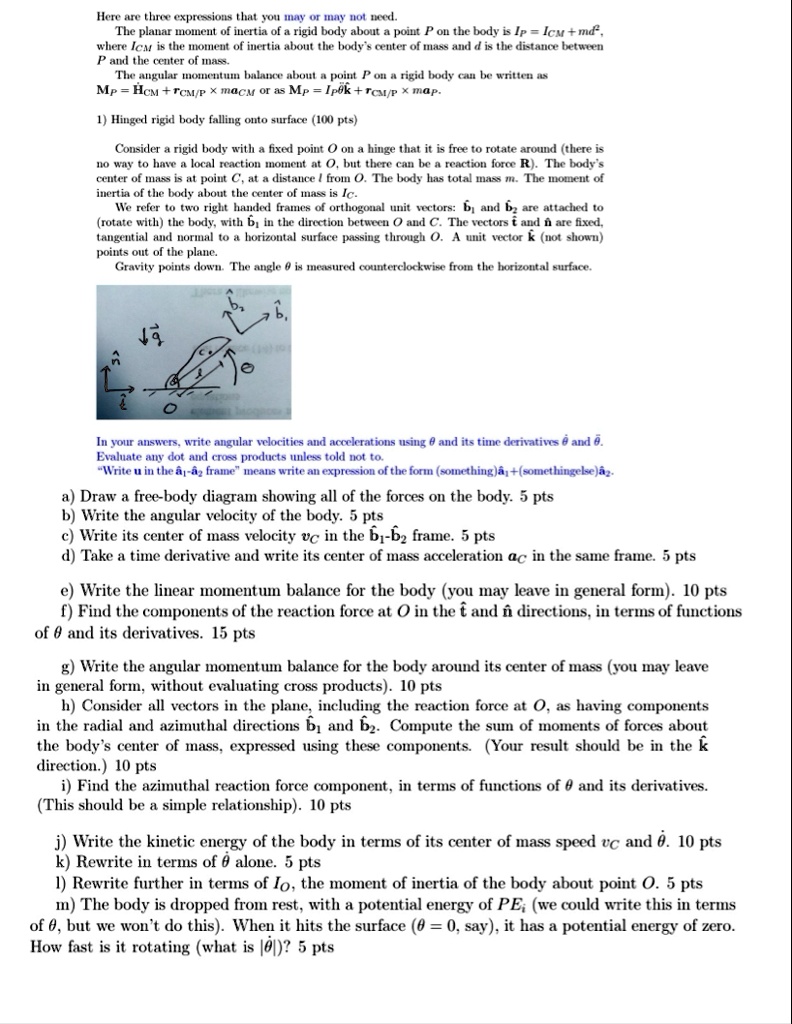
Here are three expressions that you may or may not need. The planar moment of inertia of a rigid body about a point P on the body is $I_P = I_{CM} + md^2$, where $I_{CM}$ is the moment of inertia about the body's center of mass and $d$ is the distance between P and the center of mass. The angular momentum balance about a point P on a rigid body can be written as $M_P = \dot{H}_{CM} + r_{C/P} \times ma_{CM}$ or as $M_P = I_P \ddot{\theta} \hat{k} + r_{C/P} \times ma_P$. 1) Hinged rigid body falling onto surface (100 pts) Consider a rigid body with a fixed point O on a hinge that it is free to rotate around (there is no way to have a local reaction moment at O, but there can be a reaction force R). The body's center of mass is at point C, at a distance $l$ from O. The body has total mass $m$. The moment of inertia of the body about the center of mass is $I_C$. We refer to two right handed frames of orthogonal unit vectors: $\hat{b}_1$ and $\hat{b}_2$ are attached to (rotate with) the body, with $\hat{b}_1$ in the direction between O and C. The vectors $\hat{t}$ and $\hat{n}$ are fixed, tangential and normal to a horizontal surface passing through O. A unit vector $\hat{k}$ (not shown) points out of the plane. Gravity points down. The angle $\theta$ is measured counterclockwise from the horizontal surface. In your answers, write angular velocities and accelerations using $\theta$ and its time derivatives $\dot{\theta}$ and $\ddot{\theta}$. Evaluate any dot and cross products unless told not to. "Write u in the $\hat{a}_1$-$\hat{a}_2$ frame" means write an expression of the form (something)$\hat{a}_1$+(somethingelse)$\hat{a}_2$. a) Draw a free-body diagram showing all of the forces on the body. 5 pts b) Write the angular velocity of the body. 5 pts c) Write its center of mass velocity $v_C$ in the $\hat{b}_1$-$\hat{b}_2$ frame. 5 pts d) Take a time derivative and write its center of mass acceleration $a_C$ in the same frame. 5 pts e) Write the linear momentum balance for the body (you may leave in general form). 10 pts f) Find the components of the reaction force at O in the $\hat{t}$ and $\hat{n}$ directions, in terms of functions of $\theta$ and its derivatives. 15 pts g) Write the angular momentum balance for the body around its center of mass (you may leave in general form, without evaluating cross products). 10 pts h) Consider all vectors in the plane, including the reaction force at O, as having components in the radial and azimuthal directions $\hat{b}_1$ and $\hat{b}_2$. Compute the sum of moments of forces about the body's center of mass, expressed using these components. (Your result should be in the $\hat{k}$ direction.) 10 pts i) Find the azimuthal reaction force component, in terms of functions of $\theta$ and its derivatives. (This should be a simple relationship). 10 pts j) Write the kinetic energy of the body in terms of its center of mass speed $v_C$ and $\dot{\theta}$. 10 pts k) Rewrite in terms of $\dot{\theta}$ alone. 5 pts l) Rewrite further in terms of $I_O$, the moment of inertia of the body about point O. 5 pts m) The body is dropped from rest, with a potential energy of $PE_i$ (we could write this in terms of $\theta$, but we won't do this). When it hits the surface ($\theta = 0$, say), it has a potential energy of zero. How fast is it rotating (what is $|\dot{\theta}|$)? 5 pts
View Answer
divider
BEST MATCH

What mass of sodium nitrite must be added to make a solution with a pH of 3.50?

View Answer
divider
BEST MATCH

Give the relation between electric field intensity and electric flux density

View Answer
divider
BEST MATCH

The time value of an option is the difference between ________. Because a(n) ________ option cannot be worth less than its intrinsic value, it cannot have a negative time value. Question 3 options: 1) the current option price and its intrinsic value; American 2) the current option price and its intrinsic value; European 3) the current option price and its present value; American 4) the current option price and its present value; European

View Answer
divider
BEST MATCH

Which of the following is an example of a real-time operating system? A) Windows 10 B) macOS C) RTOS D) Ubuntu

View Answer
divider
BEST MATCH

Case study/ care plan. You are working in the internal medicine clinic of a large teaching hospital. Today your first patient is 70- year-old J.M., a patient who has been coming to the clinic for several years for management of coronary artery disease (CAD) and hypertension ( HTN). He has had episodes of dizziness for the past 6 months and orthostatic hypotension , shoulder discomfort , and decreased exercise tolerance for the past 2 months. On his last clinic visit 3 weeks ago, a chest x-ray (CXR) showed cardiomegaly, and a 12-lead electrocardiogram (ECG) showed sinus tachycardia with left bundle branch block (LBBB)

View Answer
divider
BEST MATCH

> In Exercises 11-12, a matrix in row echelon form is given. By inspection, find a basis for the row space and for the column space of that matrix. 1 -3 0 1 (b) 11. (a) 1 2 4 57 1 5 2 -1 1 -3 1 4 3 (b) 12. (a) | 0 1 -7

View Answer
divider
BEST MATCH

#include // standard input and output library int main(void) // main function – code block { ENTER CODE HINT: Use the pseudo code to help document your program. return 0; } // end main function and program 5.5. Pseudo code. Remember the Input, process, output model. Look at what the input should be, what the process is, and what the output should be. Use the code examples in the book and our week 1 lab to understand how to code the input, process, and output. Pseudo code Prompt for initial input "Enter product number. (hint: use puts) "Enter -1 for the product number to end input. (hint: use puts) Declare an integer to store a product number Accept user input for product number(hint:use scanf Declare an initialize to O.0 a double to store current total retail value Loop while sentinel value not read from user for product number (hint: use a while loop where product number not equal to -1) Prompt user to enter quantity of products (hint: use puts) Declare an integer to store a product quantity Accept user input for quantity of current product sold o Use switch statement to determine product retail information then perform calculation o Use table to set case number (We have only 5 possible case statements based on product number. You will to also need a default statement if value entered is not -1,or 1 - 5) - Each case will calculate a running total of retail (use the+=operator based on quantity multiplied by the retail price for each product. zimage.png Use the break statement to exit the case. Be sure to create a default case statement if user enters a value other than 1-5 or -1 Prompt user for another product, Enter another product number or -1 to end input. Accept user input by storing in product number variable Continue loop until use enters -1 for product number Display total retail value End program 6. Program Code: (Remember to use the grading checklist below and include header comments and comments in your code) /* COSC1420 Lab04:Calculating Sales Programmer: Enter Student Name Date: Enter date program written */

View Answer
divider