Ace - AI Tutor
Ask Our Educators
Textbooks
My Library
Flashcards
Scribe - AI Notes
Notes & Exams
Download App
michael figueroa

michael f.

Divider

Questions asked

BEST MATCH

Current Attempt in Progress Samples of rejuvenated mitochondria are mutated (defective) in 1% of cases. Suppose 14 samples are studied, and they can be considered to be independent for mutation. Determine the following probabilities. (a) No samples are mutated. (b) At most one sample is mutated. (c) More than half the samples are mutated. Round your answers to two decimal places (e.g. 0.98). (a) The probability is .8687 (b) The probability is (c) The probability is

View Answer
divider
BEST MATCH

Which BS offers guidance on harmonised core colours? a) BS 7777 b) BS 7671 c) BS 6700 d) BS 4470

View Answer
divider
BEST MATCH

use spherical coordinates to evaluate \int \int \int (x^(2)+y^(2)+z^(2))dV where E is the solid in the first octant. E is bounded by the coordinate planes and x^(2)+y^(2)+z^(2)=9

View Answer
divider
BEST MATCH

Question content area top Part 1 Find the angle between negative 3 Bold i minus 5 Bold j−3i−5j and Bold jj. Question content area bottom Part 1 The angle between negative 3 Bold i minus 5 Bold j−3i−5j and Bold jj is enter your response heredegrees°. (Round to the nearest tenth as needed.)

View Answer
divider
BEST MATCH

Asset A has an expected return of 15% and a reward-to-variability ratio of 0.4. Asset B has an expected return of 20% and a reward-to-variability ratio of 0.3. A risk-averse investor would prefer a portfolio using the risk-free asset and __________. asset B The answer cannot be determined from the data given. no risky asset asset A

View Answer
divider
BEST MATCH

stion 12 of 15 > vo beakers each contain 200 mL of water. Into one beaker, a student adds 5.0 g NaCl. Into the other, she adds 5.0 g KCI.

View Answer
divider
BEST MATCH

Select all of the following that are true of Mollusca. metanephridia for excretion respire by diffusion not gills complete digestive tract incomplete digestive tract nervous system with brain closed circulatory system in most classes flame cells for excretion malpighian tubules for excretion open circulatory system in most classes efficient gills in marine species

View Answer
divider
BEST MATCH

In the next few quarters, what will be the most likely major policy move by the Federal Reserve? raise reserve requirement lower reserve requirement raise interest rates to indict congress leadsrs for their incompetence keep interest rates at a very low level

View Answer
divider
BEST MATCH

What is the middle layer of tissues called in a triplobast? What sorts of "things" does it make? Group of answer choices Mesoderm. Muscles, circulatory system, bones, reproductive systems. Ectoderm. The skin. Mesoderm. Digestive tracts and stomach. Endoderm. The digestive tract and stomach.

View Answer
divider
BEST MATCH

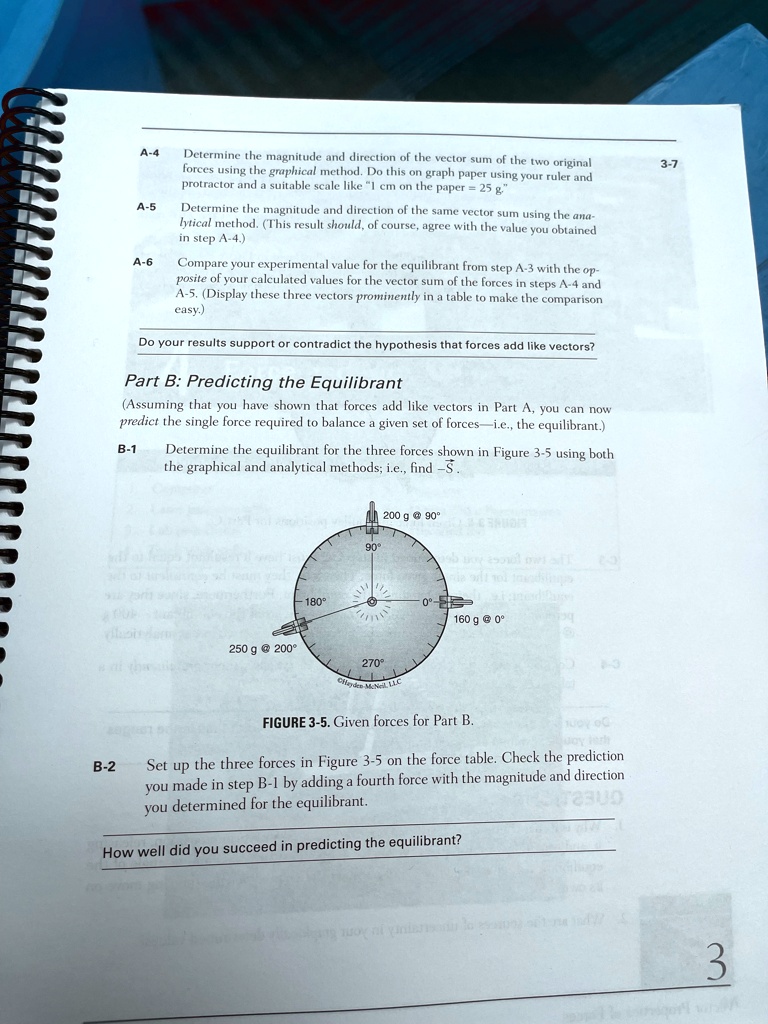
A-4 Determine the magnitude and direction of the vector sum of the two original forces using the graphical method. Do this on graph paper using your ruler and protractor and a suitable scale like "1 cm on the paper = 25 g." A-5 Determine the magnitude and direction of the same vector sum using the analytical method. (This result should, of course, agree with the value you obtained in step A-4.) A-6 Compare your experimental value for the equilibrant from step A-3 with the opposite of your calculated values for the vector sum of the forces in steps A-4 and A-5. (Display these three vectors prominently in a table to make the comparison easy.) Do your results support or contradict the hypothesis that forces add like vectors? Part B: Predicting the Equilibrant (Assuming that you have shown that forces add like vectors in Part A, you can now predict the single force required to balance a given set of forces - i.e., the equilibrant.) B-1 Determine the equilibrant for the three forces shown in Figure 3-5 using both the graphical and analytical methods; i.e., find -vec(S). FIGURE 3-5. Given forces for Part B. B-2 Set up the three forces in Figure 3-5 on the force table. Check the prediction you made in step B-1 by adding a fourth force with the magnitude and direction you determined for the equilibrant. How well did you succeed in predicting the equilibrant? Force 1: Mass (160g) Angle (0 degrees) Force 2: Mass (200g) Angle (90 degrees) Force 3: Mass (250g) Angle (200 degrees) Force 4: Mass (100g) Angle (296 degrees) I need help graphing the 4 forces using a protractor (part B)
View Answer
divider