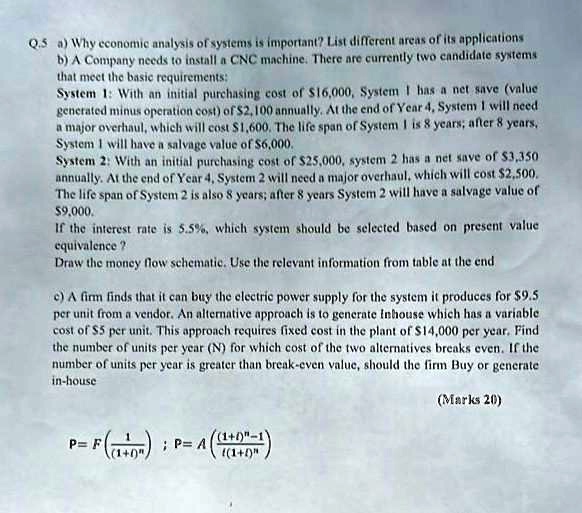
Q.5 a) Why economic analysis of systems is important? List different areas of its applications
b) A Company needs to install a CNC machine. There are currently two candidate systems
that meet the basic requirements:
System 1: With an initial purchasing cost of $16,000, System I has a net save (value
generated minus operation cost) of $2,100 annually. At the end of Year 4, System I will need
a major overhaul, which will cost $1,600. The life span of System 1 is 8 years; after 8 years,
System 1 will have a salvage value of $6,000.
System 2: With an initial purchasing cost of $25,000, system 2 has a net save of $3,350
annually. At the end of Year 4, System 2 will need a major overhaul, which will cost $2,500.
The life span of System 2 is also 8 years; after 8 years System 2 will have a salvage value of
$9,000.
If the interest rate is 5.5%, which system should be selected based on present value
equivalence ?
Draw the money flow schematic. Use the relevant information from table at the end
c) A firm finds that it can buy the electric power supply for the system it produces for $9.5
per unit from a vendor. An alternative approach is to generate Inhouse which has a variable
cost of $5 per unit. This approach requires fixed cost in the plant of $14,000 per year. Find
the number of units per year (N) for which cost of the two alternatives breaks even. If the
number of units per year is greater than break-even value, should the firm Buy or generate
in-house
$P = F \left( \frac{1}{(1+i)^n} \right)$ ; $P = A \left( \frac{(1+i)^n - 1}{i(1+i)^n} \right)$
(Marks 20)