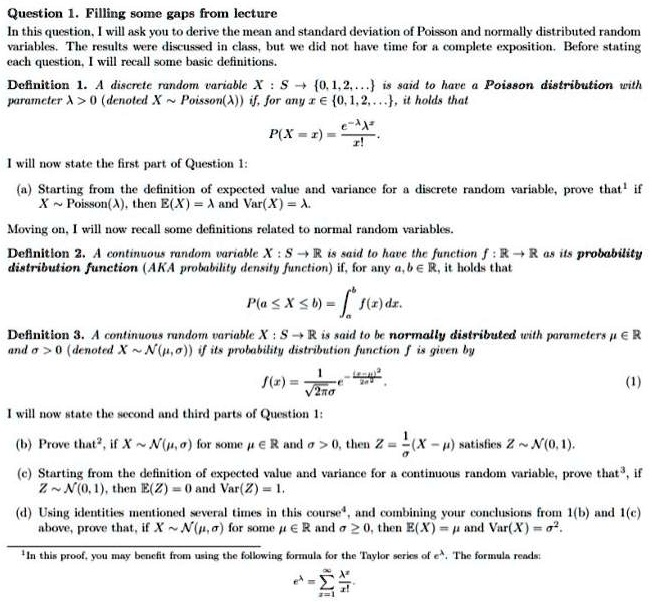
Question 1. Filling some gaps from lecture. In this question, I will ask you to derive the mean and standard deviation of Poisson and normally distributed random variables. The results were discussed in class, but we did not have time for a complete exposition. Before stating each question, I will recall some basic definitions.
Definition 1. A discrete random variable X ∈ {0,1,2,...} is said to have a Poisson distribution with parameter λ > 0, denoted X ~ Poisson(λ), if for any x ∈ {0,1,2,...}, it holds that
P(X = x) = (e^(-λ) * λ^x) / x!
I will now state the first part of Question 1:
a) Starting from the definition of expected value and variance for a discrete random variable, prove that if X ~ Poisson(λ), then E(X) = λ and Var(X) = λ.
Moving on, I will now recall some definitions related to normal random variables.
Definition 2. A continuous random variable X ∈ â„ is said to have the function f: ℠→ â„ as its probability distribution function (AKA probability density function) if, for any a,b ∈ â„, it holds that
P(a ≤ X ≤ b) = ∫(a to b) f(x) dx
Definition 3. A continuous random variable X ∈ ℠is said to be normally distributed with parameters μ ∈ ℠and σ > 0 (denoted X ~ N(μ,σ)), if its probability distribution function f is given by
f(x) = (1 / (σ * √(2π))) * e^(-((x-μ)^2) / (2σ^2))
I will now state the second and third parts of Question 1:
b) Prove that, if X ~ N(μ,σ) for some μ ∈ ℠and σ > 0, then Z = (X-μ)/σ satisfies Z ~ N(0,1).
c) Starting from the definition of expected value and variance for a continuous random variable, prove that if Z ~ N(0,1), then E(Z) = 0 and Var(Z) = 1.
d) Using identities mentioned several times in this course, and combining your conclusions from 1(b) and 1(c) above, prove that if X ~ N(μ,σ) for some μ ∈ ℠and σ > 0, then E(X) = μ and Var(X) = σ^2.
In this proof, you may benefit from using the following formula for the Taylor series of e. The formula reads:
e^x = 1 + x + (x^2 / 2!) + (x^3 / 3!) + ...