Ace - AI Tutor
Ask Our Educators
Textbooks
My Library
Flashcards
Scribe - AI Notes
Notes & Exams
Download App
michael hughes

michael h.

Divider

Questions asked

BEST MATCH

Provide an appropriate response. Find (dy/dt) for y = ( ((5t) with superscript (2) - 4t)) with superscript (2).

View Answer
divider
BEST MATCH

Which patients are not included in the hospital death rate? Group of answer choices patients who die in the intensive care unit patients who die in the emergency department patients who die in medical-surgical units patients who die after three days in the hospital

View Answer
divider
BEST MATCH

The healthcare provider prescribes oxytocin, 0.5 million units per minute for a client and labor. 1 L ringers is lactate. With 10 units of oxytocin is infusing the nurse program the infusion pumped. How many milliliters per hour.

View Answer
divider
BEST MATCH

describe how you would make 1 L of a 0.1 M succinate buffer with a pH of 6 using only solid succinic acid, and aqueous 1 M sodium hydroxide solution, and deionized water. Give the amount of succinic acid needed in grams and the amount of 1 M NaOH solution needed in milliliters.

View Answer
divider
BEST MATCH

Oxygen is added to blood as it flows through the ____ circuit. O body O portal O pulmonary O oxygen O systemic Question 44

View Answer
divider
BEST MATCH

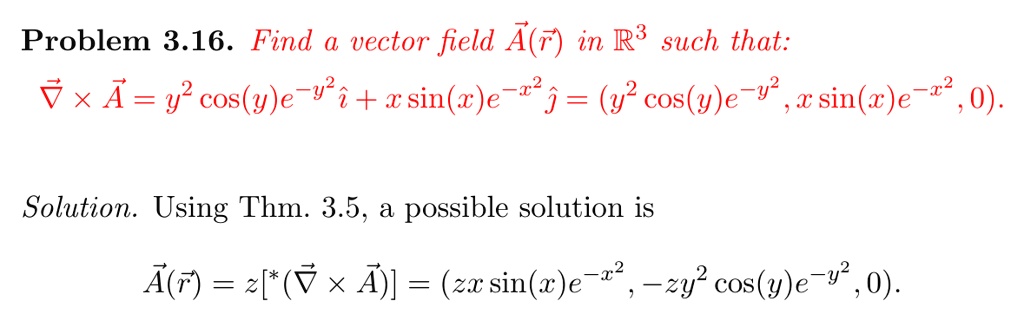
Problem 3.16. Find a vector field \(\vec{A}(\vec{r})\) in \(\mathbb{R}^3\) such that: \(\vec{\nabla} \times \vec{A} = y^2 \cos(y)e^{-y^2}\hat{i} + x \sin(x)e^{-x^2}\hat{j} = (y^2 \cos(y)e^{-y^2}, x \sin(x)e^{-x^2}, 0)\). Solution. Using Thm. 3.5, a possible solution is \(\vec{A}(\vec{r}) = z^*(\vec{\nabla} \times \vec{A}) = (zx \sin(x)e^{-x^2}, -zy^2 \cos(y)e^{-y^2}, 0).\)
View Answer
divider
BEST MATCH

3. Estimate the distance to a galaxy whose redshift indicates that it is moving away from us at a speed of 22,000 km/s. Assume that Hubble's constant is 22 km/s/Mly. 4. What is the mass-to-light ratio of a 30 $M_{sun}$ supergiant star with luminosity 300,000 $L_{sun}$? 5. The Milky Way Galaxy contains about 90 billion solar masses of material within the Sun's orbit, and the total luminosity of stars within that same region is about 15 billion solar luminosities. What is the mass-to-light ratio in our galaxy within the Sun's orbit?

View Answer
divider
BEST MATCH

Which was key in the eradication of smallpox? Group of answer choices Finding a cure for the disease Coordination of all countries in battling the disease Education among the patients Controlling the final outbreak

View Answer
divider
BEST MATCH

19. During the power stroke A. acetylcholine (ACh) diffuse across the synaptic cleft and bind to ACh receptors. B. Ca$^{2+}$ is pumped back to sarcoplasmic reticulum. C. myosin crossbridge swivels and pulls actin toward M line. D. None of the above 20. Somatic motor neurons control A. cardiac muscles B. glands C. skeletal muscles D. smooth muscles 21. Spinal reflexes are integrated in the brain. A. True B. False 22. A muscle develops its maximal force at its maximal length. A. True B. False 23. Sensory transduction converts stimuli into graded potentials. A. True B. False 24. What is TRUE about the refractory period? A. Action potentials will not fire during the refractory period. B. Refractory period is due to voltage-gated Na$^+$ channels resetting. C. The refractory period prevents backward conduction. D. Only A and B E. A and B and C 25. What is true about sensory pathways in the brain? A. Equilibrium pathways project primarily to the cerebellum. B. Most sensory pathways pass through the thalamus on their way to the cerebral cortex. C. Olfactory pathways from the nose project through the olfactory bulb to the olfactory cortex. D. None of the above E. A and B and C 26. The resting membrane potential results only from the concentration gradients of Na$^+$ and K$^+$ . A. True B. False

View Answer
divider
BEST MATCH

Use the Trapezoidal Rule with n = 4 steps to estimate the integral.\\ $\int_0^2 (x^4+1) dx$\\ You may use one of the following formulas:\\ $M(n) = f(m_1)\Delta x + f(m_2)\Delta x + ... + f(m_n)\Delta x = \sum_{k=1}^n f(\frac{x_{k-1}+x_k}{2})\Delta x$\\ $T(n) = [\frac{1}{2}f(x_0) + \sum_{i=1}^{n-1} f(x_i) + \frac{1}{2}f(x_n)]\Delta x$\\ A. $\frac{145}{16}$\ B. $\frac{101}{12}$\ C. $\frac{145}{8}$\ D. $\frac{217}{16}$

View Answer
divider