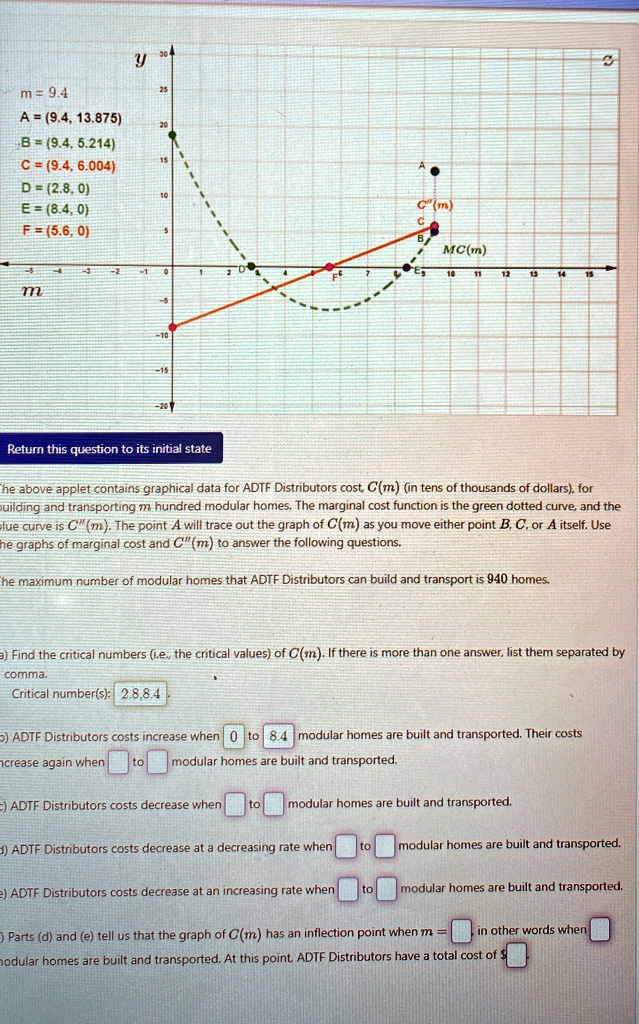
m = 9.4
A = (9.4, 13.875)
B = (9.4, 5.214)
C = (9.4, 6.004)
D = (2.8, 0)
E = (8.4, 0)
F = (5.6, 0)
The above applet contains graphical data for ADTF Distributors cost, $C(m)$ (in tens of thousands of dollars), for building and transporting $m$ hundred modular homes. The marginal cost function is the green dotted curve, and the blue curve is $C''(m)$. The point A will trace out the graph of $C(m)$ as you move either point B, C, or A itself. Use the graphs of marginal cost and $C''(m)$ to answer the following questions.
The maximum number of modular homes that ADTF Distributors can build and transport is 940 homes.
a) Find the critical numbers (i.e., the critical values) of $C(m)$. If there is more than one answer, list them separated by comma.
Critical number(s): 2.8,8.4
b) ADTF Distributors costs increase when 0 to 8.4 modular homes are built and transported. Their costs increase again when $\boxed{}$ to $\boxed{}$ modular homes are built and transported.
c) ADTF Distributors costs decrease when $\boxed{}$ to $\boxed{}$ modular homes are built and transported.
d) ADTF Distributors costs decrease at a decreasing rate when $\boxed{}$ to $\boxed{}$ modular homes are built and transported.
e) ADTF Distributors costs decrease at an increasing rate when $\boxed{}$ to $\boxed{}$ modular homes are built and transported.
Parts (d) and (e) tell us that the graph of $C(m)$ has an inflection point when $m = \boxed{}$ in other words when $\boxed{}$ modular homes are built and transported. At this point, ADTF Distributors have a total cost of $\boxed{$}$