Prelab for FTIR experiment.
Please answer questions in the lab part.
Like, how does pD relate to pH?
Why do we need to correct concentration?
What regions of FTIR spectra should I be focusing on and why?
Thank you.
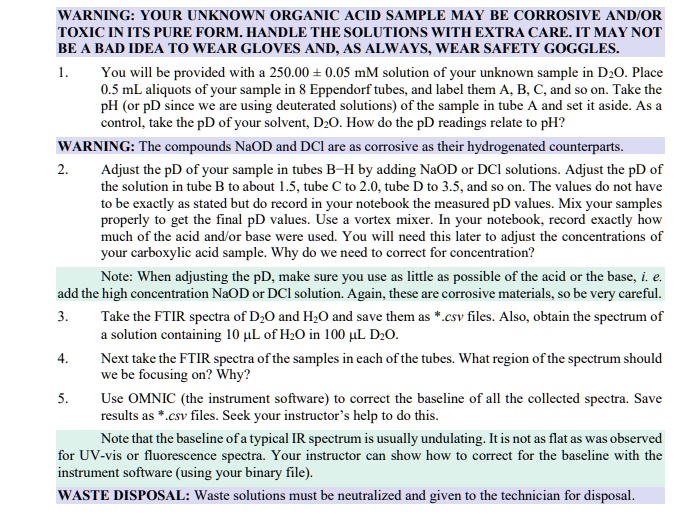
WARNING: YOUR UNKNOWN ORGANIC ACID SAMPLE MAY BE CORROSIVE AND/OR TOXIC IN ITS PURE FORM. HANDLE THE SOLUTIONS WITH EXTRA CARE. IT MAY NOT BE A BAD IDEA TO WEAR GLOVES AND, AS ALWAYS, WEAR SAFETY GOGGLES.
1. You will be provided with a 250.00 ± 0.05 mM solution of your unknown sample in D2O. Place 0.5 mL aliquots of your sample in 8 Eppendorf tubes and label them A, B, C, and so on. Take the pH (or pD since we are using deuterated solutions) of the sample in tube A and set it aside. As a control, take the pD of your solvent, D2O. How do the pD readings relate to pH?
WARNING: The compounds NaOD and DCl are as corrosive as their hydrogenated counterparts.
2. Adjust the pD of your sample in tubes B, H by adding NaOD or DCl solutions. Adjust the pD of the solution in tube B to about 1.5, tube C to 2.0, tube D to 3.5, and so on. The values do not have to be exactly as stated, but do record in your notebook the measured pD values. Mix your samples properly to get the final pD values. Use a vortex mixer. In your notebook, record exactly how much of the acid and/or base was used. You will need this later to adjust the concentrations of your carboxylic acid sample. Why do we need to correct for concentration?
Note: When adjusting the pD, make sure you use as little as possible of the acid or the base, i.e. add the high concentration NaOD or DCl solution. Again, these are corrosive materials, so be very careful.
3. Take the FTIR spectra of D2O and H2O and save them as *.csv files. Also, obtain the spectrum of a solution containing 10 L of H2O in 100 L D2O.
4. Next, take the FTIR spectra of the samples in each of the tubes. What region of the spectrum should we be focusing on? Why?
5. Use OMNIC (the instrument software) to correct the baseline of all the collected spectra. Save the results as *.csv files. Seek your instructor's help to do this.
Note that the baseline of a typical IR spectrum is usually undulating. It is not as flat as was observed for UV-vis or fluorescence spectra. Your instructor can show how to correct for the baseline with the instrument software (using your binary file).
WASTE DISPOSAL: Waste solutions must be neutralized and given to the technician for disposal.