Ace - AI Tutor
Ask Our Educators
Textbooks
My Library
Flashcards
Scribe - AI Notes
Notes & Exams
Download App
michael losada

michael l.

Divider

Questions asked

BEST MATCH

On a test, if 107 questions are answered and 42 of them are correct, what is the percent of correct answers? (Enter the percentage rounded to the nearest hundredth without the percent sign)

View Answer
divider
BEST MATCH

What happens when two non-compatible blood types are mixed together? 21 Multiple Choice Phagocytosis Opsonization Coagulation Agglutination

View Answer
divider
BEST MATCH

Work together anywhere a handbook on working remotely successfully : for individuals, teams & managers

View Answer
divider
BEST MATCH

Aggregate supply shifts with changes in production cost, what causes changes in production costs?

View Answer
divider
BEST MATCH

Imagine a government that imposes a Pigouvian carbon tax. That tax raises a very large annual revenue. The government then has to decide how to distribute that revenue. Which of the following ways of distribution will NOT shift demand for fossil fuels to the right? Group of answer choices A cut in the income tax rate for households with income below median income An investment tax credit that increases investment in physical capital An equal payment to all households A subsidy for wind farms

View Answer
divider
BEST MATCH

Book Problem 8 Use part I of the Fundamental Theorem of Calculus to find the derivative of $F(x) = \int_x^4 \tan(t^5)dt$ $F'(x) = $

View Answer
divider
BEST MATCH

Question 2 (23 points) The U.S. Department of Agriculture is interested in analyzing the domestic market for corn. The USDA's staff economists estimate the following equations for the demand and supply curves: $Q_d = 1,500 - 125P + 10I$ $Q_s = 440 + 165P$ Where $Q_d$ and $Q_s$ are quantity demanded and supplied respectively; P is corn's price; I is consumers' income in thousands. Quantities are measured in millions of bushels; prices are measured in dollars per bushel. a) (4 points) Suppose income I=$10 (thousand). Calculate the equilibrium price and quantity that will prevail. b) (7 points) Calculate the income elasticities of demand at the equilibrium values. Is core a normal good or inferior good? If consumers' income increases 5%, what would be the percentage change in the demand for corn? c) (8 points) Calculate the price elasticities of supply and demand at the equilibrium values. Is demand or supply more sensitive to price change? What is the revenue for farmers from their production of corn at the equilibrium? Is it a good idea for farmers to increase price or decrease price? Why? d) (4 points) If government decides to implement tax on corn production. Which side (demand side or supply side) will share the tax burden more? Why?

View Answer
divider
BEST MATCH

Write a program that evaluates the following arithmetic expression: Result1 = ((1.5 + Val1) / 2) + \sqrt{Val2} Result2 = 2.5 * Result1 Ask the user to enter the values of the variables, Val1 and Val2 (positive float values). Display the resulting value on the screen (Result1 and Result2). Example: Val1 = 0.9 Val2 = 0.8 The result will be: Result1 = 2.094 Result2 = 5.2

View Answer
divider
BEST MATCH

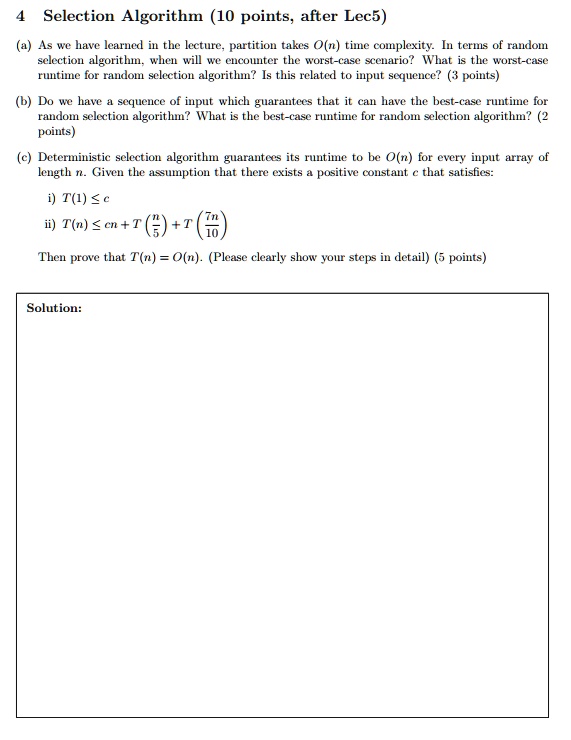
4 Selection Algorithm (10 points, after Lec5) (a) As we have learned in the lecture, partition takes O(n) time complexity. In terms of random selection algorithm, when will we encounter the worst-case scenario? What is the worst-case runtime for random selection algorithm? Is this related to input sequence? (3 points) (b) Do we have a sequence of input which guarantees that it can have the best-case runtime for random selection algorithm? What is the best-case runtime for random selection algorithm? (2 points) (c) Deterministic selection algorithm guarantees its runtime to be O(n) for every input array of length n. Given the assumption that there exists a positive constant e that satisfies: i) T(1) ? c ii) T(n) ? cn + T(\frac{n}{5}) + T(\frac{7n}{10}) Then prove that T(n) = O(n). (Please clearly show your steps in detail) (5 points) Solution:
View Answer
divider
BEST MATCH

At the instant \( \alpha = 4 \) rad/s, pulley A is given an angular acceleration \( \alpha = (0.9\theta) \) rad/s\( ^2 \), where \( \theta \) is in radians. Pulley C has an inner hub which is fixed to its outer one and turns with it. (Figure 1) Part A Determine the magnitude of acceleration of point B on pulley C when A rotates 3 revolutions Express your answer to three significant figures and include the appropriate units.

View Answer
divider