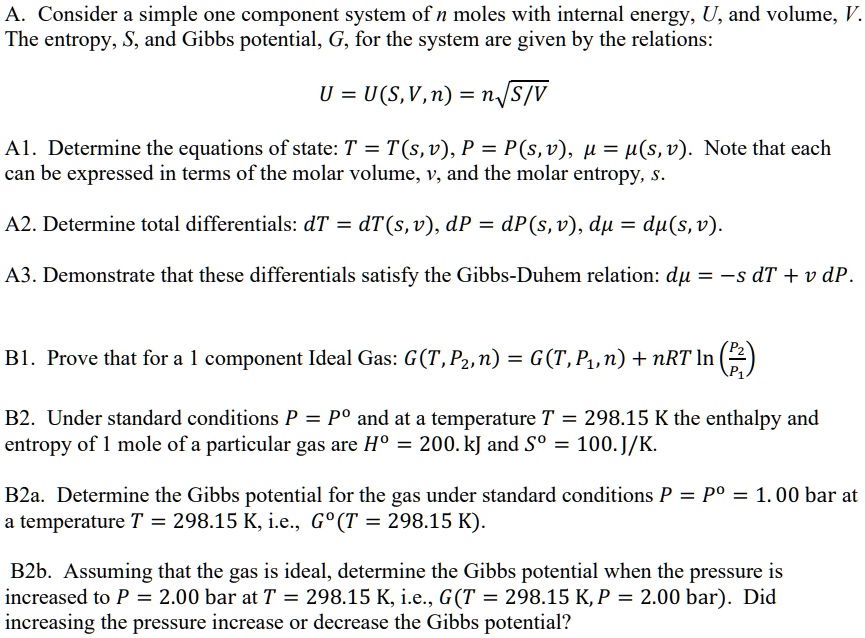
A. Consider a simple one-component system of n moles with internal energy, U, and volume, V. The entropy, S, and Gibbs potential, G, for the system are given by the relations:
U = U(S,V,n) = nVS/V
Al. Determine the equations of state: T = T(s,v), P = P(s,v), Ï = Ï(s,v). Note that each can be expressed in terms of the molar volume, v, and the molar entropy, s.
A2. Determine total differentials: dT = dT(s,v), dP = dP(s,v), dÏ = dÏ(s,v)
A3. Demonstrate that these differentials satisfy the Gibbs-Duhem relation: dG = -s dT + v dP
B1. Prove that for a 1-component Ideal Gas: G(T,P2,n) = G(T,P,n) + nRT ln(P2/P)
B2. Under standard conditions P = p and at a temperature T = 298.15 K, the enthalpy and entropy of 1 mole of a particular gas are H = 200 kJ and S0 = 100 J/K
B2a. Determine the Gibbs potential for the gas under standard conditions P = po = 1.00 bar at a temperature T = 298.15 K, i.e., G(T = 298.15 K).
B2b. Assuming that the gas is ideal, determine the Gibbs potential when the pressure is increased to P = 2.00 bar at T = 298.15 K, i.e., G(T = 298.15 K, P = 2.00 bar). Did increasing the pressure increase or decrease the Gibbs potential?