4) The Mountain Train
In a mountainous area, tourists can
travel with a mountain train to a
beautiful viewpoint. An electric motor
supplies the driving force Fm to the
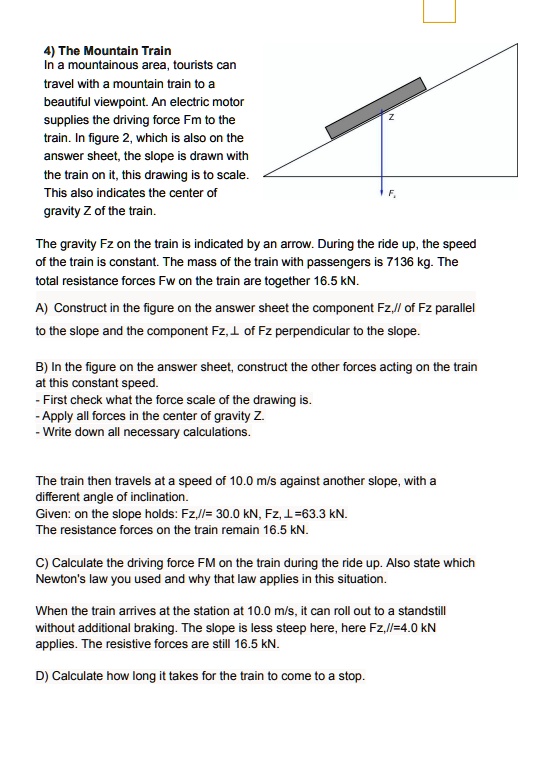
train. In figure 2, which is also on the
answer sheet, the slope is drawn with
the train on it, this drawing is to scale.
This also indicates the center of
gravity Z of the train.
Z
F
The gravity Fz on the train is indicated by an arrow. During the ride up, the speed
of the train is constant. The mass of the train with passengers is 7136 kg. The
total resistance forces Fw on the train are together 16.5 kN.
A) Construct in the figure on the answer sheet the component $F_{z, //}$ of $F_z$ parallel
to the slope and the component $F_{z, \perp}$ of $F_z$ perpendicular to the slope.
B) In the figure on the answer sheet, construct the other forces acting on the train
at this constant speed.
- First check what the force scale of the drawing is.
- Apply all forces in the center of gravity Z.
- Write down all necessary calculations.
The train then travels at a speed of 10.0 m/s against another slope, with a
different angle of inclination.
Given: on the slope holds: $F_{z, //}$= 30.0 kN, $F_{z, \perp}$=63.3 kN.
The resistance forces on the train remain 16.5 kN.
C) Calculate the driving force FM on the train during the ride up. Also state which
Newton's law you used and why that law applies in this situation.
When the train arrives at the station at 10.0 m/s, it can roll out to a standstill
without additional braking. The slope is less steep here, here $F_{z, //}$=4.0 kN
applies. The resistive forces are still 16.5 kN.
D) Calculate how long it takes for the train to come to a stop.