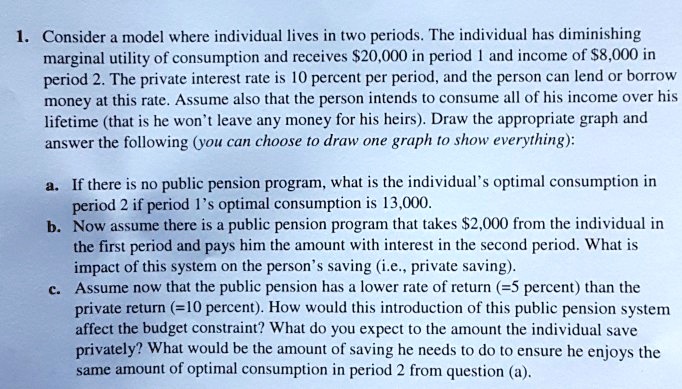
1. Consider a model where individual lives in two periods. The individual has diminishing
marginal utility of consumption and receives $20,000 in period 1 and income of $8,000 in
period 2. The private interest rate is 10 percent per period, and the person can lend or borrow
money at this rate. Assume also that the person intends to consume all of his income over his
lifetime (that is he won't leave any money for his heirs). Draw the appropriate graph and
answer the following (you can choose to draw one graph to show everything):
a. If there is no public pension program, what is the individual's optimal consumption in
period 2 if period 1's optimal consumption is 13,000.
b. Now assume there is a public pension program that takes $2,000 from the individual in
the first period and pays him the amount with interest in the second period. What is
impact of this system on the person's saving (i.e., private saving).
c. Assume now that the public pension has a lower rate of return (=5 percent) than the
private return (=10 percent). How would this introduction of this public pension system
affect the budget constraint? What do you expect to the amount the individual save
privately? What would be the amount of saving he needs to do to ensure he enjoys the
same amount of optimal consumption in period 2 from question (a).