Task 3: True and Approximate Relative Error (15 pts)
Solve problem 3.7 from the Chapra and Canale text (below) and follow the supplemental instructions
below. To clarify what the problem is asking, you are to compute the true percent relative error after
every iteration (there should be 20 of these error values) and the approximate percent relative error
between successive approximations (so there should be 19 of these).
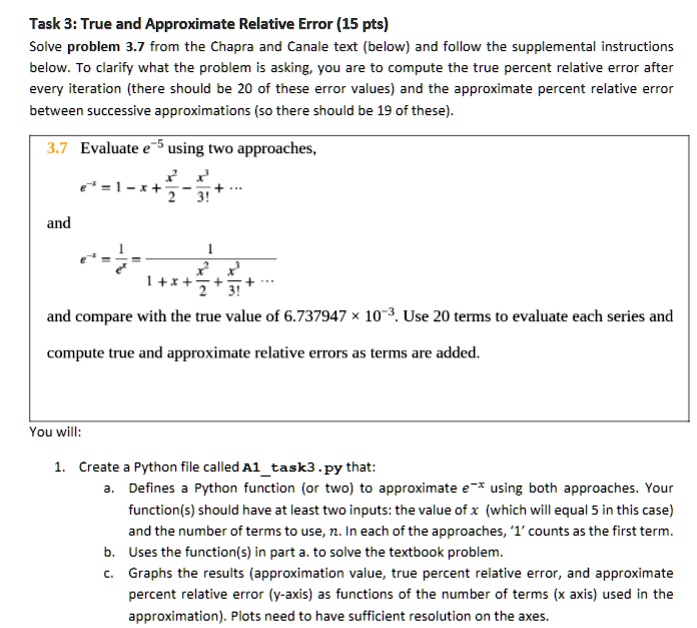
3.7 Evaluate $e^{-5}$ using two approaches,
$e^{-x} = 1 - x + \frac{x^2}{2} - \frac{x^3}{3!} + ...$
and
$e^{-x} = \frac{1}{e^x} = \frac{1}{1 + x + \frac{x^2}{2} + \frac{x^3}{3!} + ...}$
and compare with the true value of $6.737947 \times 10^{-3}$. Use 20 terms to evaluate each series and
compute true and approximate relative errors as terms are added.
You will:
1. Create a Python file called A1_task3.py that:
a. Defines a Python function (or two) to approximate $e^{-x}$ using both approaches. Your
function(s) should have at least two inputs: the value of x (which will equal 5 in this case)
and the number of terms to use, n. In each of the approaches, '1' counts as the first term.
b. Uses the function(s) in part a. to solve the textbook problem.
c. Graphs the results (approximation value, true percent relative error, and approximate
percent relative error (y-axis) as functions of the number of terms (x axis) used in the
approximation). Plots need to have sufficient resolution on the axes.