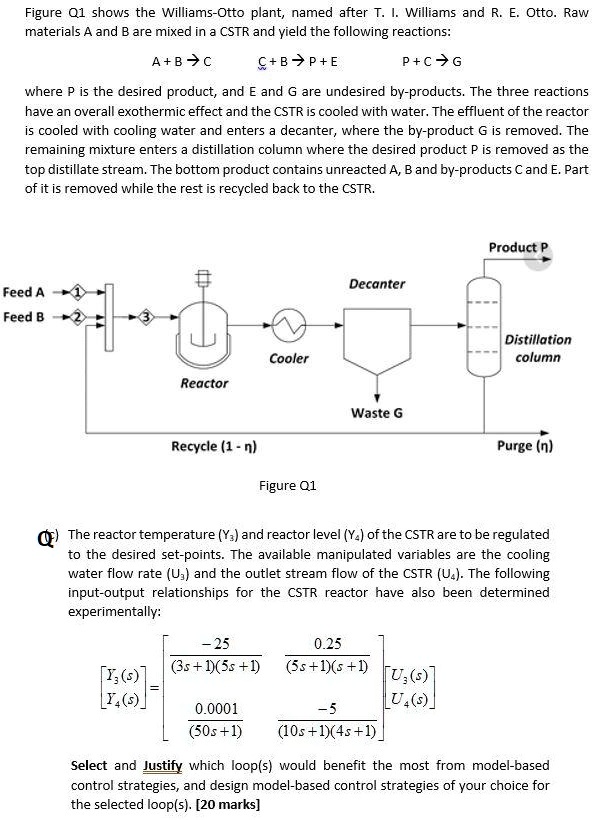
Figure 01 shows the Williams-Otto plant, named after T. I. Williams and R. E. Otto. Raw materials A and B are mixed in a CSTR and yield the following reactions: A+B>C, C+B>P+E, P+C>6 where P is the desired product, and E and G are undesired by-products. The three reactions have an overall exothermic effect and the CSTR is cooled with water. The effluent of the reactor is cooled with cooling water and enters a decanter, where the by-product G is removed. The remaining mixture enters a distillation column where the desired product P is removed as the top distillate stream. The bottom product contains unreacted A, B, and by-products C and E. Part of it is removed while the rest is recycled back to the CSTR. Product P, Decanter, Feed A, Feed B, Distillation column, Cooler, Reactor, Waste, Recycle (1-n), Purge (n) Figure
Figure Q1 shows the Williams-Otto plant, named after T. I. Williams and R. E. Otto. Raw materials A and B are mixed in a CSTR and yield the following reactions: A+B>C, C+B>3, P+C>G where P is the desired product, and E and G are undesired by-products. The three reactions have an overall exothermic effect and the CSTR is cooled with water. The effluent of the reactor is cooled with cooling water and enters a decanter, where the by-product G is removed. The remaining mixture enters a distillation column where the desired product P is removed as the top distillate stream. The bottom product contains unreacted A, B, and by-products C and E. Part of it is removed while the rest is recycled back to the CSTR. Product P, Feed A, Decanter, Feed B 2, Distillation column, Cooler, Reactor, Waste G, Recycle (1-n), Purge (n) Figure Q1
to the desired set-points. The available manipulated variables are the cooling water flow rate (U) and the outlet stream flow of the CSTR (U). The following input-output relationships for the CSTR reactor have also been determined experimentally: -25, 0.25, 3s+15s+1, 5s+1s+1, [Y] Us], Y4s], Us 0.0001, 50s+1, 10s+14+1. Select and Justify which loop(s) would benefit the most from model-based control strategies, and design model-based control strategies of your choice for the selected loop(s). [20 marks]