6th ELA
Nonfiction: Cite Textual Evidence DQ1:2 Date:
As you answer this week's questions, highlight your evidence in the text.
The Five-Second Rule
According to the "5-second rule," food that is dropped on the floor is okay to ea
long as it's picked up within 5 seconds. But should fallen food really be going into th
instead of into our mouths? Scientific research has put the 5-second rule to the test
he answer is...it depends.
The length of time food spends on the floor
n't the only determining factor when it
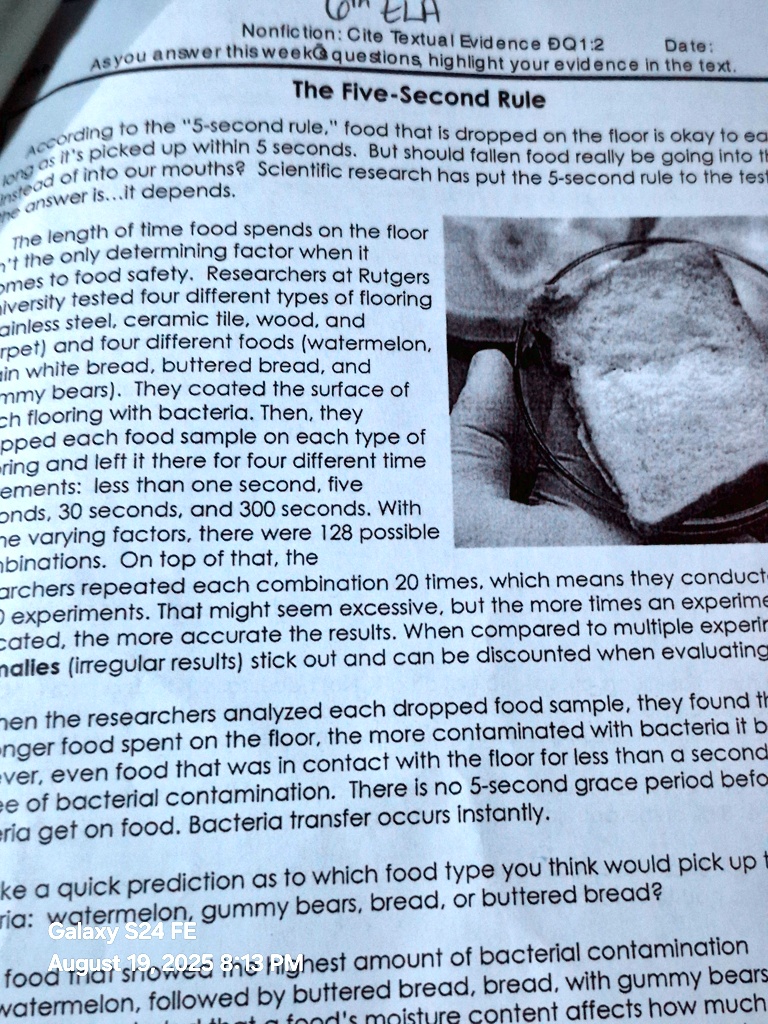
comes to food safety. Researchers at Rutgers
University tested four different types of flooring
(stainless steel, ceramic tile, wood, and
carpet) and four different foods (watermelon,
plain white bread, buttered bread, and
gummy bears). They coated the surface of
each flooring with bacteria. Then, they
dropped each food sample on each type of
flooring and left it there for four different time
elements: less than one second, five
seconds, 30 seconds, and 300 seconds. With
the varying factors, there were 128 possible
combinations. On top of that, the
researchers repeated each combination 20 times, which means they conducte
20 experiments. That might seem excessive, but the more times an experime
cated, the more accurate the results. When compared to multiple experim
malies (irregular results) stick out and can be discounted when evaluating
Then the researchers analyzed each dropped food sample, they found th
onger food spent on the floor, the more contaminated with bacteria it b
ever, even food that was in contact with the floor for less than a second
ee of bacterial contamination. There is no 5-second grace period befo
eria get on food. Bacteria transfer occurs instantly.
ake a quick prediction as to which food type you think would pick up t
ria: watermelon, gummy bears, bread, or buttered bread?
Galaxy S24 FE
August 19, 2025 8:13 PM
food that showed the highest amount of bacterial contamination
watermelon, followed by buttered bread, bread, with gummy bears
that a food's moisture content affects how much