With regard to these costs:
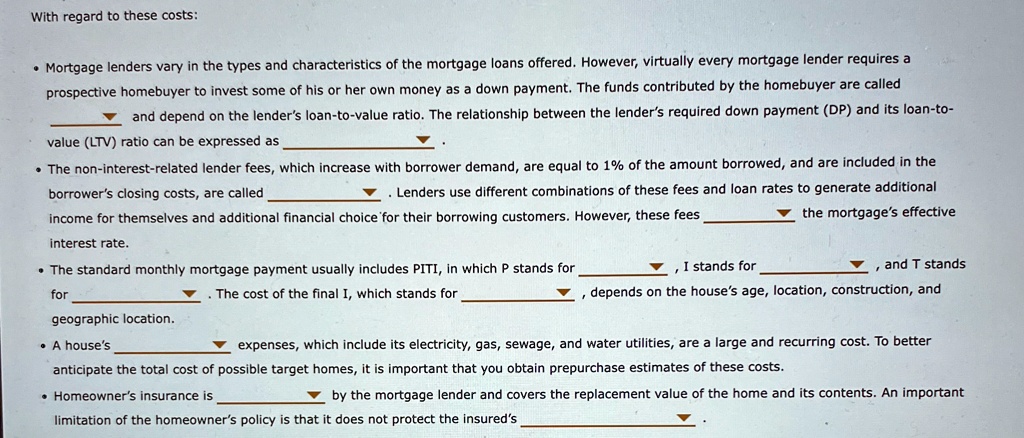
* Mortgage lenders vary in the types and characteristics of the mortgage loans offered. However, virtually every mortgage lender requires a prospective homebuyer to invest some of his or her own money as a down payment. The funds contributed by the homebuyer are called down payment and depend on the lender's loan-to-value ratio. The relationship between the lender's required down payment (DP) and its loan-to-value (LTV) ratio can be expressed as a percentage.
* The non-interest-related lender fees, which increase with borrower demand, are equal to 1% of the amount borrowed, and are included in the borrower's closing costs, are called points. Lenders use different combinations of these fees and loan rates to generate additional income for themselves and additional financial choice for their borrowing customers. However, these fees affect the mortgage's effective interest rate.
* The standard monthly mortgage payment usually includes PITI, in which P stands for principal, I stands for interest, and T stands for taxes. The cost of the final I, which stands for insurance, depends on the house's age, location, construction, and geographic location.
* A house's operating expenses, which include its electricity, gas, sewage, and water utilities, are a large and recurring cost. To better anticipate the total cost of possible target homes, it is important that you obtain prepurchase estimates of these costs.
* Homeowner's insurance is required by the mortgage lender and covers the replacement value of the home and its contents. An important limitation of the homeowner's policy is that it does not protect the insured's land.