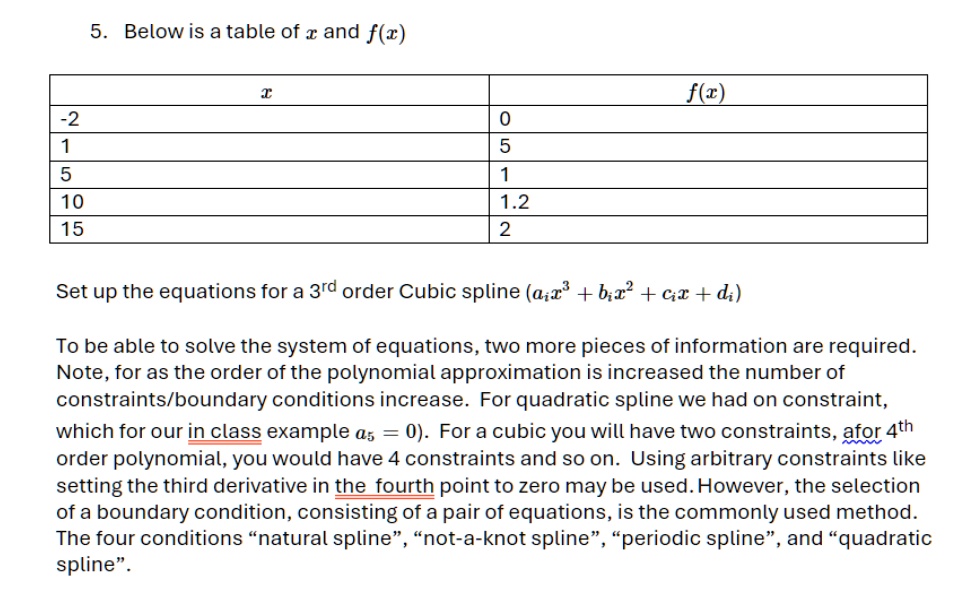
-2
1
5
10
15
5. Below is a table of *x* and *f(x)*
*x*
0
5
1
1.2
2
*f(x)*
Set up the equations for a 3rd order Cubic spline (*a<sub>i</sub>x³ + b<sub>i</sub>x² + c<sub>i</sub>x + d<sub>i</sub>*)
To be able to solve the system of equations, two more pieces of information are required.
Note, for as the order of the polynomial approximation is increased the number of
constraints/boundary conditions increase. For quadratic spline we had on constraint,
which for our in class example *a<sub>5</sub>* = 0). For a cubic you will have two constraints, afor 4th
order polynomial, you would have 4 constraints and so on. Using arbitrary constraints like
setting the third derivative in the fourth point to zero may be used. However, the selection
of a boundary condition, consisting of a pair of equations, is the commonly used method.
The four conditions "natural spline", "not-a-knot spline", "periodic spline", and "quadratic
spline".