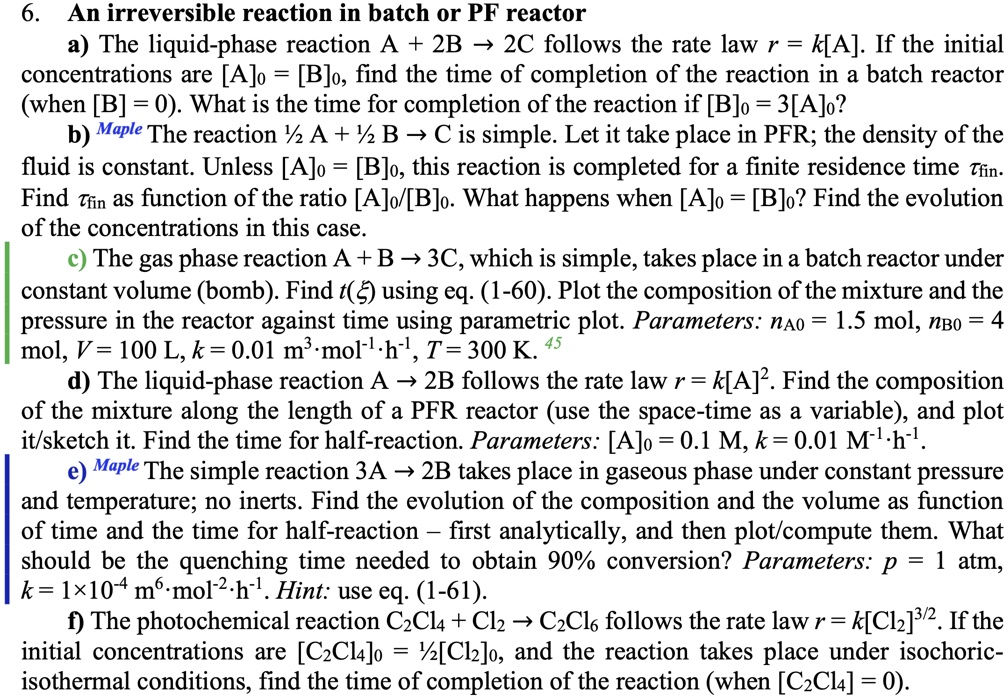
6. An irreversible reaction in batch or PF reactor:
a) The liquid-phase reaction A + 2B -> 2C follows the rate law r = k[A]. If the initial concentrations are [A]o = [B]o, find the time of completion of the reaction in a batch reactor (when [B] = 0). What is the time for completion of the reaction if [B]o = 3[A]o?
b) Maple The reaction 1/2 A + 1/ B -> C is simple. Let it take place in PFR; the density of the fluid is constant. Unless [A]o = [B]o, this reaction is completed for a finite residence time tfin. Find tfin as a function of the ratio [A]o/[B]o. What happens when [A]o = [B]o? Find the evolution of the concentrations in this case.
c) The gas phase reaction A + B -> 3C, which is simple, takes place in a batch reactor under constant volume (bomb). Find t() using eq. (1-60). Plot the composition of the mixture and the pressure in the reactor against time using a parametric plot. Parameters: nao = 1.5 mol, nBo = 4 mol, V = 100 L, k = 0.01 m3.mol-1.h-1, T = 300 K.
d) The liquid-phase reaction A -> 2B follows the rate law r = k[A]2. Find the composition of the mixture along the length of a PFR reactor (use the space-time as a variable), and plot it/sketch it. Find the time for half-reaction. Parameters: [A]o = 0.1 M, k = 0.01 M-1.h-1.
e) Maple The simple reaction 3A -> 2B takes place in the gaseous phase under constant pressure and temperature; no inerts. Find the evolution of the composition and the volume as a function of time and the time for half-reaction -- first analytically, and then plot/compute them. What should be the quenching time needed to obtain 90% conversion? Parameters: p = 1 atm, k = 1*10^-4 m.mol-2.h-1. Hint: use eq. (1-61).
f) The photochemical reaction C2Cl4 + Cl2 -> C2Cl6 follows the rate law r = k[Cl2]3/2. If the initial concentrations are [CCl4]o = /[Cl2]o, and the reaction takes place under isochoric- isothermal conditions, find the time of completion of the reaction (when [C2Cl4] = 0).