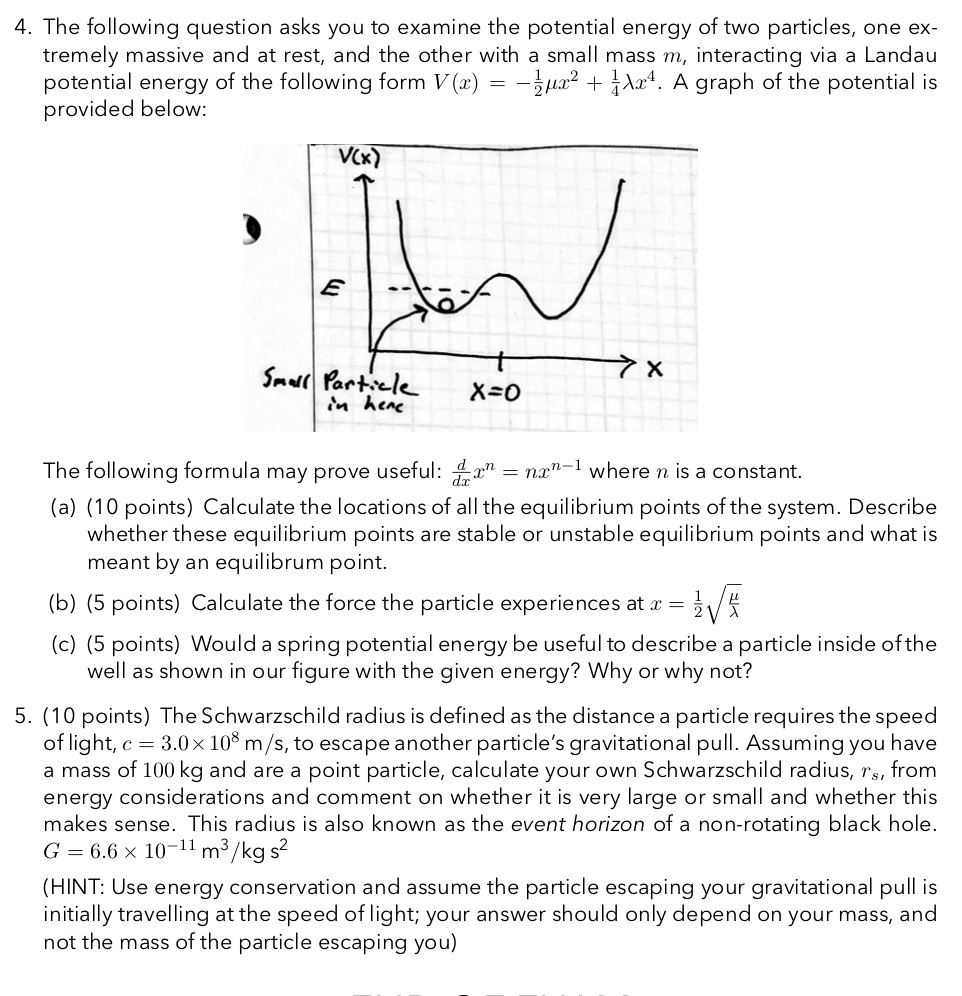
4. The following question asks you to examine the potential energy of two particles, one extremely massive and at rest, and the other with a small mass m, interacting via a Landau potential energy of the following form V(x) = -2x^2 + 1x^4. A graph of the potential is provided below:
V(x)
E
Small Particle in Well
x
X=0
(a) (10 points) Calculate the locations of all the equilibrium points of the system. Describe whether these equilibrium points are stable or unstable equilibrium points and what is meant by an equilibrium point.
(b) (5 points) Calculate the force the particle experiences at x = 0.
(c) (5 points) Would a spring potential energy be useful to describe a particle inside of the well as shown in our figure with the given energy? Why or why not?
5. (10 points) The Schwarzschild radius is defined as the distance a particle requires to escape another particle's gravitational pull when the particle is moving at the speed of light, c = 3.0 x 10^8 m/s. Assuming you have a mass of 100 kg and are a point particle, calculate your own Schwarzschild radius, rs, using the formula:
rs = 2GM/c^2
where G = 6.6 x 10^-11 m^3/kg s^2. This radius is also known as the event horizon of a non-rotating black hole.
(HINT: Use energy conservation and assume the particle escaping your gravitational pull is initially traveling at the speed of light; your answer should only depend on your mass, and not the mass of the particle escaping you)