QUESTION 3 (Start on a new page.)
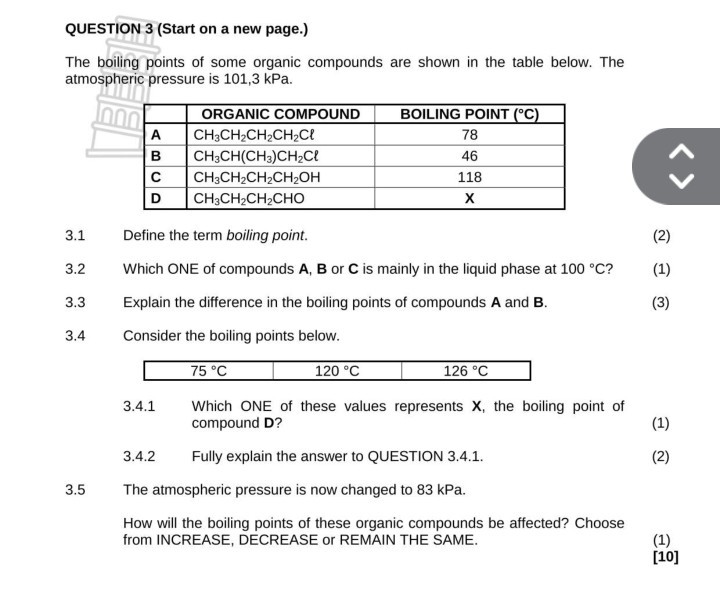
The boiling points of some organic compounds are shown in the table below. The atmospheric pressure is \( 101,3 \mathrm{kPa} \).
\begin{tabular}{|c|c|c|}
\hline & ORGANIC COMPOUND & BOILING POINT \( \left({ }^{\circ} \mathrm{C}\right) \) \\
\hline A & \( \mathrm{CH}_{3} \mathrm{CH}_{2} \mathrm{CH}_{2} \mathrm{CH}_{2} \mathrm{Cl} \) & 78 \\
\hline B & \( \mathrm{CH}_{3} \mathrm{CH}\left(\mathrm{CH}_{3}\right) \mathrm{CH}_{2} \mathrm{Cl} \) & 46 \\
\hline C & \( \mathrm{CH}_{3} \mathrm{CH}_{2} \mathrm{CH}_{2} \mathrm{CH}_{2} \mathrm{OH} \) & 118 \\
\hline D & \( \mathrm{CH}_{3} \mathrm{CH}_{2} \mathrm{CH}_{2} \mathrm{CHO} \) & \( \mathrm{X} \) \\
\hline
\end{tabular}
3.1 Define the term boiling point.
3.2 Which ONE of compounds \( \mathbf{A}, \mathbf{B} \) or \( \mathbf{C} \) is mainly in the liquid phase at \( 100^{\circ} \mathrm{C} \) ?
3.3 Explain the difference in the boiling points of compounds \( \mathbf{A} \) and \( \mathbf{B} \).
3.4 Consider the boiling points below.
\begin{tabular}{|c|c|c|}
\hline \( 75^{\circ} \mathrm{C} \) & \( 120^{\circ} \mathrm{C} \) & \( 126^{\circ} \mathrm{C} \) \\
\hline
\end{tabular}
3.4.1 Which ONE of these values represents \( \mathrm{X} \), the boiling point of compound \( \mathbf{D} \) ?
3.4.2 Fully explain the answer to QUESTION 3.4.1.
3.5 The atmospheric pressure is now changed to \( 83 \mathrm{kPa} \).
How will the boiling points of these organic compounds be affected? Choose from INCREASE, DECREASE or REMAIN THE SAME.
\( (1) \)
\( [10] \)