Ace - AI Tutor
Ask Our Educators
Textbooks
My Library
Flashcards
Scribe - AI Notes
Notes & Exams
Download App
michael sellers

michael s.

Divider

Questions asked

BEST MATCH

An SRS of 23 students at UH gave an average height of 5.6 feet and a standard deviation of .1 feet. Construct a 90% confidence interval for the mean height of students at UH. (5.593, 5.607) (4.100, 7.400) (5.428, 5.772) (4.350, 7.050) (5.564, 5.636) None of the above

View Answer
divider
BEST MATCH

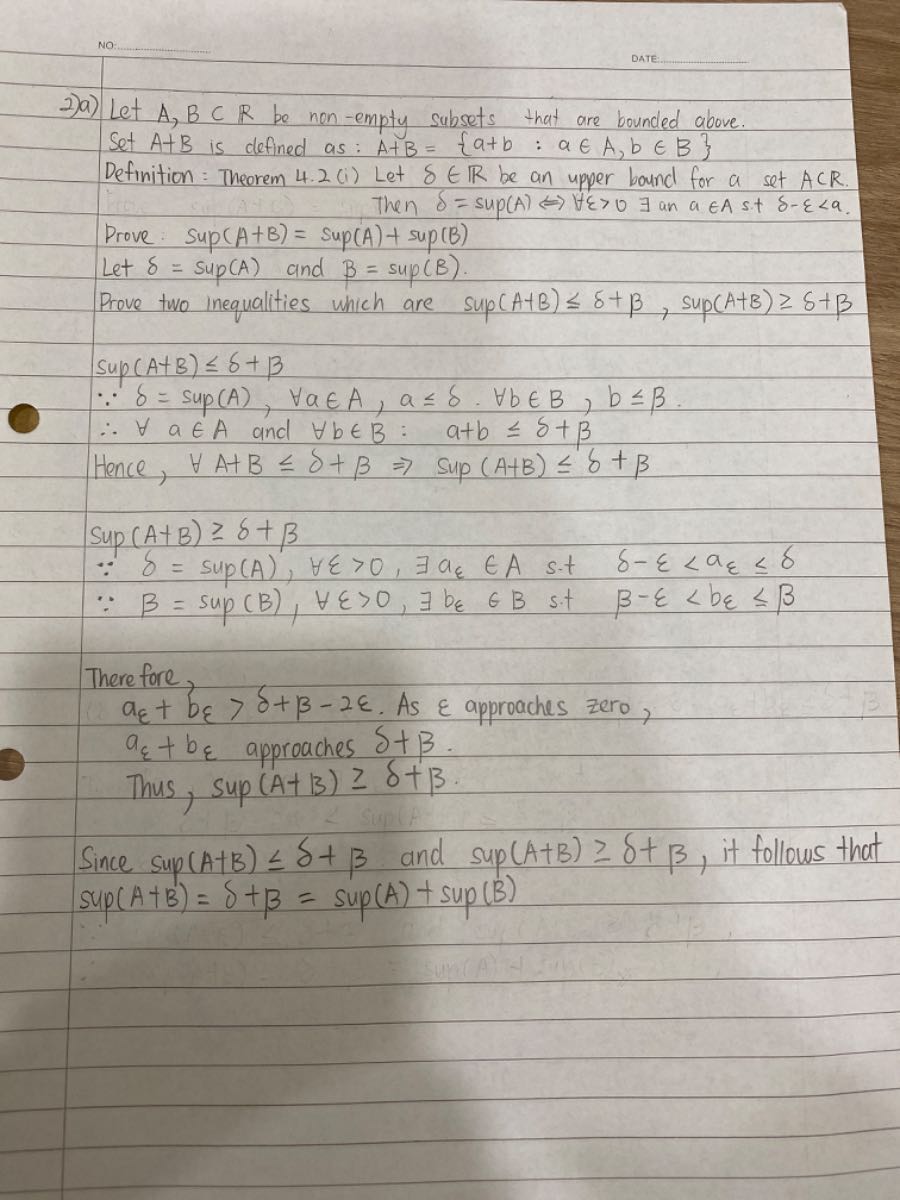
NO DATE: 2)a) Let \( A, B \subset \mathbb{R} \) be non-empty subsets that are bounded above. Set \( A+B \) is defined as: \( A+B=\{a+b: a \in A, b \in B\} \) Definition: Theorem 4.2 (i) Let \( \delta \in \mathbb{R} \) be an upper bound for a set \( A C R \). Then \( \delta=\sup (A) \Leftrightarrow \forall \varepsilon>0 \exists \) an \( a \in A \) s.t \( \delta-\varepsilon<a \). Prove: \( \sup (A+B)=\sup (A)+\sup (B) \) Let \( \delta=\sup (A) \) and \( B=\sup (B) \). Prove two inequalities which are \( \sup (A+B) \leq \delta+\beta, \sup (A+B) \geq \delta+\beta \) \[ \sup (A+B) \leqslant \delta+B \] \( \because \delta=\sup (A), \forall a \in A, a \leq \delta . \forall b \in B, b \leq \beta \). \( \therefore \forall a \in A \) and \( \forall b \in B: \quad a+b \leq \delta+\beta \) Hence, \( \forall A+B \leq \delta+\beta \Rightarrow \sup (A+B) \leq \delta+\beta \) \[ \begin{array}{l} \sup (A+B) \geq \delta+\beta \\ \because \delta=\sup (A), \forall \varepsilon>0, \exists a_{\varepsilon} \in A \text { s.t } \delta-\varepsilon<a_{\varepsilon} \leq \delta \\ \because \beta=\sup (B), \forall \varepsilon>0, \exists b_{\varepsilon} \in B \text { s.t } \beta-\varepsilon<b_{\varepsilon} \leq \beta \end{array} \] Therefore, \( a_{\varepsilon}+b_{\varepsilon}>\delta+\beta-2 \varepsilon \). As \( \varepsilon \) approaches zero, \( a_{\varepsilon}+b_{\varepsilon} \) approaches \( \delta+\beta \). Thus, \( \sup (A+B) \geq \delta+\beta \). Since \( \sup (A+B) \leq \delta+\beta \) and \( \sup (A+B) \geq \delta+B \), it follows that \( \sup (A+B)=\delta+\beta=\sup (A)+\sup (B) \)
View Answer
divider
BEST MATCH

Question 3 of 20 Let $h = \frac{v_0^2}{4.9}sin\theta cos\theta$ model the horizontal distance in meters traveled by a projectile. If the initial velocity is 44 meters/second, which equation would you use to find the angle needed to travel 150 meters? A. 197.55sin(2$\theta$) = 150 B. 395.10sin(2$\theta$) = 150 C. 150sin(2$\theta$) = 150 D. 8.98sin(2$\theta$) = 150

View Answer
divider
BEST MATCH

?Moving to another question will save this response. Question 2 Given the following set of numbers: 124 126 127 128 130 132 132 139 144 148 149 155 170 Find: a) n = b) \sum x = c) \bar{x} = Mean = (round answer to two decimal places.) d) Median = e) Mode = f) Is the distribution right skewed, left skewed or symmetric?

View Answer
divider
BEST MATCH

When a tariff or quota on a product is removed, this policy action

View Answer
divider
BEST MATCH

Which of the following negative environmental impact is specifically associated with fracturing? Select one: a. Carbon emission b. Risk of earthquakes c. Water contamination d. Loss of biodiversity

View Answer
divider
BEST MATCH

Draw a whole and shade $\frac{3}{4}$.

View Answer
divider
BEST MATCH

Evaluate the expression for q = -8.7. Write your answer as a decimal or whole number. -1.3q =

View Answer
divider
BEST MATCH

2. Carry out each calculation and report the answer according to the correct number of significant figures.\ a) 53.5 \times 0.41\ b) 65.2/12\ c) 25.825 - 3.86\ d) 41.0 + 9.135\ e) 694.2 \times 0.2\ f) (2.55 \times 10^3) (4.0 \times 10^4)\ g) (8.00 \times 10^5) / (2 \times 10^{-2})

View Answer
divider
BEST MATCH

Temperature (°C) Graph Analysis 1 2 3 4 E D 2 3 4 5 6 7 8 9 10 11 12 13 Time (min) 5. At which numbered section(s) is/are kinetic energy of the molecules the greatest? 6. Relate your answer to #5 to the associated intermolecular force of the molecules. 7. Evaluate the change in temperature from point A to E, with regard to heat. 8. Draw the missing section of this heating curve on the graph and label the phase that best fits. Using the terms temperature and heat, justify (prove) your chosen phase.

View Answer
divider