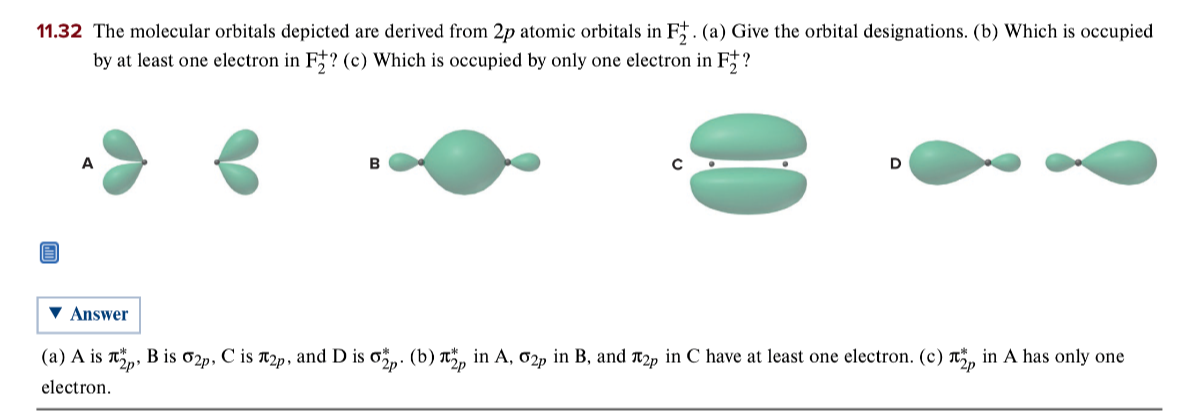
11.32 The molecular orbitals depicted are derived from \( 2 p \) atomic orbitals in \( \mathrm{F}_{2}^{+} \). (a) Give the orbital designations. (b) Which is occupied by at least one electron in \( \mathrm{F}_{2}^{+} \)? (c) Which is occupied by only one electron in \( \mathrm{F}_{2}^{+} \)?
A
C
D
Answer
(a) \( \mathrm{A} \) is \( \pi_{2 p}^{*}, \mathrm{~B} \) is \( \sigma_{2 p}, \mathrm{C} \) is \( \pi_{2 p} \), and \( \mathrm{D} \) is \( \sigma_{2 p}^{*} \). (b) \( \pi_{2 p}^{*} \) in \( \mathrm{A}, \sigma_{2 p} \) in \( \mathrm{B} \), and \( \pi_{2 p} \) in \( \mathrm{C} \) have at least one electron. (c) \( \pi_{2 p}^{*} \) in \( \mathrm{A} \) has only one electron.