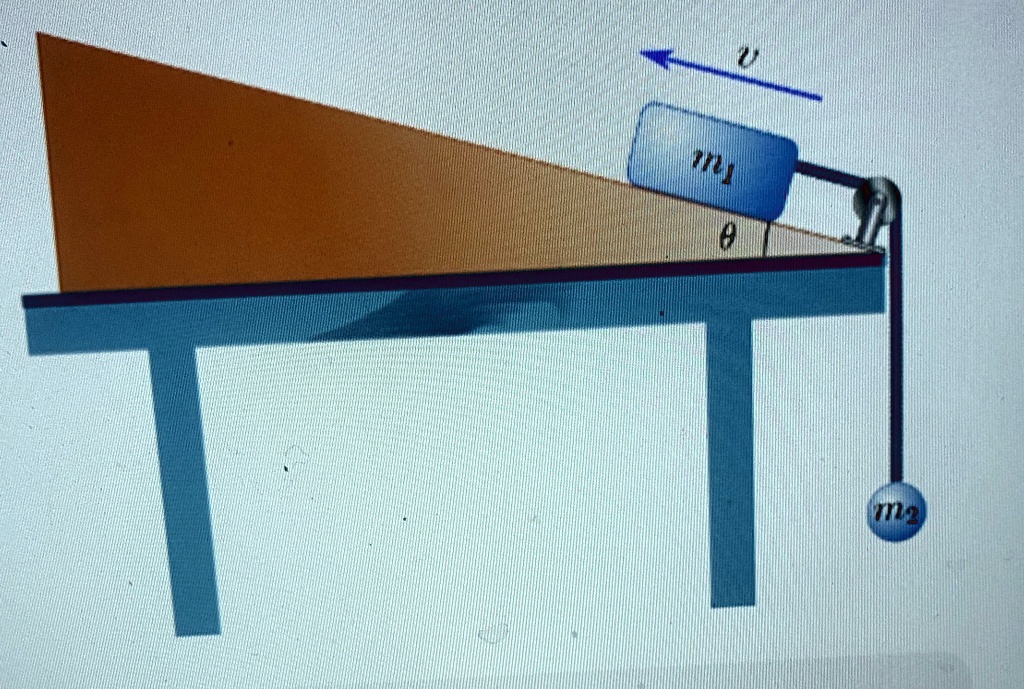
An inclined plane, at angle θ=22.1∘ with the horizontal, is constructed on a table. A box, with mass m1=2.97kg, is placed on the inclined plane, and it is attached to an ideal, meaning massless and inelastic, cord that passes over an ideal, meaning massless and frictionless, pulley. The other end of the cord is attached to a sphere of mass m2=0.338kg. The box is given an initial velocity with magnitude v=3.29m/s directed parallel to and up the inclined plane, as shown in the sketch. The coefficient of kinetic friction is 0.21.
Part (a)
What is the distance, in meters, that the box travels up the inclined plane before coming to rest?
d=
Part (b)
What is the minimum value of the coefficient of static friction such that, after coming to a stop, the box remains at rest and does not accelerate down the inclined box?
μs =