Question 4
Let {X1, X2, ..., Xn} and {Y1, Y2, ..., Ym} be independent random samples from n(??, ??²) and
?(??, ??²) respectively. Furthermore, it is known that c?x² = d?y², with ?x², and ?y² are
unknown parameters, and c, and d are known constants.
(a) Construct a 100(1 - ?)% confidence interval for ?? - ??.
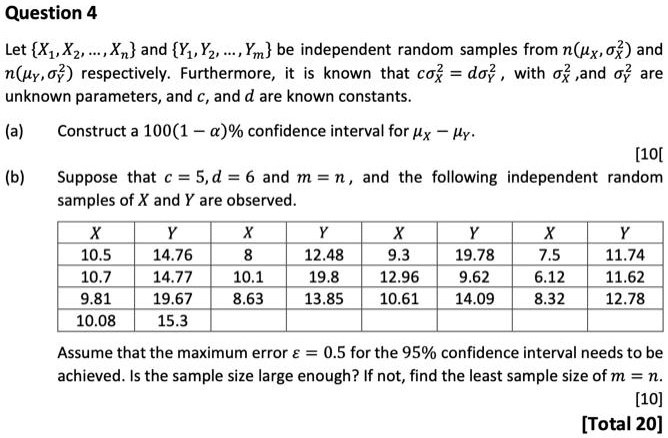
(b) Suppose that c = 5, d = 6 and m = n, and the following independent random
samples of X and Y are observed.
X Y X Y X Y X Y
10.5 14.76 8 12.48 9.3 19.78 7.5 11.74
10.7 14.77 10.1 19.8 12.96 9.62 6.12 11.62
9.81 19.67 8.63 13.85 10.61 14.09 8.32 12.78
10.08 15.3
Assume that the maximum error ? = 0.5 for the 95% confidence interval needs to be
achieved. Is the sample size large enough? If not, find the least sample size of m = n.