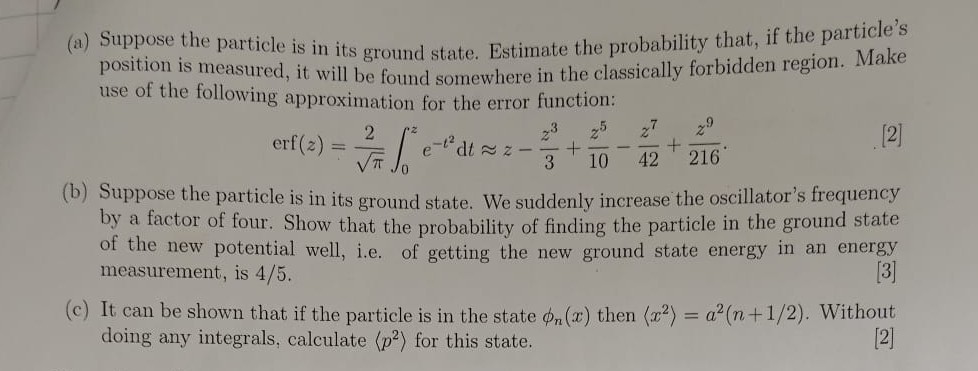
(a) Suppose the particle is in its ground state. Estimate the probability that, if the particle's position is measured, it will be found somewhere in the classically forbidden region. Make use of the following approximation for the error function:
\[
\operatorname{erf}(z)=\frac{2}{\sqrt{\pi}} \int_{0}^{z} e^{-t^{2}} \mathrm{~d} t \approx z-\frac{z^{3}}{3}+\frac{z^{5}}{10}-\frac{z^{7}}{42}+\frac{z^{9}}{216}
\]
(b) Suppose the particle is in its ground state. We suddenly increase the oscillator's frequency by a factor of four. Show that the probability of finding the particle in the ground state of the new potential well, i.e. of getting the new ground state energy in an energy measurement, is \( 4 / 5 \).
(c) It can be shown that if the particle is in the state \( \phi_{n}(x) \) then \( \left\langle x^{2}\right\rangle=a^{2}(n+1 / 2) \). Without doing any integrals, calculate \( \left\langle p^{2}\right\rangle \) for this state.
[2]