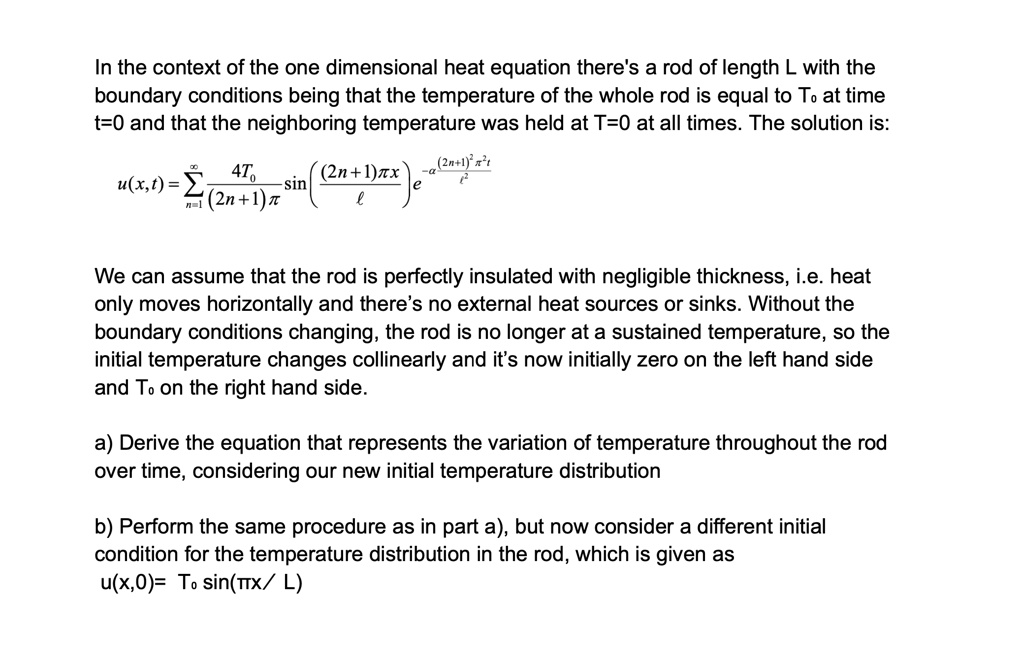
In the context of the one dimensional heat equation there's a rod of length L with the
boundary conditions being that the temperature of the whole rod is equal to To at time
t=0 and that the neighboring temperature was held at T=0 at all times. The solution is:
\begin{equation}
u(x,t) = \sum_{n=1}^{\infty} \frac{4T_0}{(2n+1)\pi} \sin\left(\frac{(2n+1)\pi x}{l}\right)e^{-\alpha \frac{(2n+1)^2 \pi^2 t}{l^2}}\end{equation}
We can assume that the rod is perfectly insulated with negligible thickness, i.e. heat
only moves horizontally and there's no external heat sources or sinks. Without the
boundary conditions changing, the rod is no longer at a sustained temperature, so the
initial temperature changes collinearly and it's now initially zero on the left hand side
and To on the right hand side.
a) Derive the equation that represents the variation of temperature throughout the rod
over time, considering our new initial temperature distribution
b) Perform the same procedure as in part a), but now consider a different initial
condition for the temperature distribution in the rod, which is given as
u(x,0)= T_0 \sin(\pi x/ L)