Ace - AI Tutor
Ask Our Educators
Textbooks
My Library
Flashcards
Scribe - AI Notes
Notes & Exams
Download App
michelle cox

michelle c.

Divider

Questions asked

BEST MATCH

In a matched-pairs case-control study, you derive the odds ratio by dividing... (circle one best answer)

View Answer
divider
BEST MATCH

13. \( \left(\frac{3}{7}\right)^{-2} \)

View Answer
divider
BEST MATCH

Rough endoplasmic reticulum (ER) : Aids in division of DNA : Site of intracellular digestion; recycles old organelles : Helps maintain the structure of the cell : Long whiplike structure; aids in cellular movement : Site of protein synthesis : Controls what materials enter/exit the cell : Contains most of the DNA of the cell : Surface studded with ribosomes

View Answer
divider
BEST MATCH

What is the life span of an erythrocyte (in days)? Question 6 options:

View Answer
divider
BEST MATCH

The Lo Three-Step Clinical Model is a clinical model for decision-making to ensure that no important considerations relating to patient care are overlooked. True False

View Answer
divider
BEST MATCH

In the Hardy-Weinberg equation, p and q are allele frequencies genotypes phenotypes measures of fitness mutation rates

View Answer
divider
BEST MATCH

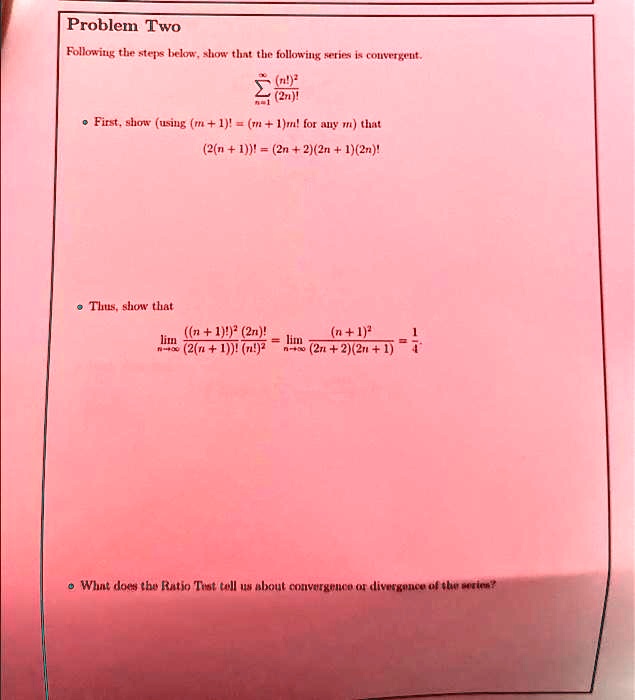
Problem Two Following the steps below, show that the following series is convergent. $\sum_{n=1}^{\infty} \frac{(n!)^2}{(2n)!}$ \begin{itemize} \item First, show (using $(m+1)! = (m+1)m!$ for any $m$) that $(2(n+1))! = (2n+2)(2n+1)(2n)!$ \item Thus, show that $\lim_{n \to \infty} \frac{((n+1)!)^2 (2n)!}{(2(n+1))! (n!)^2} = \lim_{n \to \infty} \frac{(n+1)^2}{(2n+2)(2n+1)} = \frac{1}{4}$ \item What does the Ratio Test tell us about convergence or divergence of the series? \end{itemize}
View Answer
divider
BEST MATCH

A hair stylist obtains a home loan for $414,000 at an annual interest rate of 4.75% compounded monthly for 30 years. Find the monthly mortgage payment (in dollars). (Round your answer to the nearest cent.)

View Answer
divider
BEST MATCH

ORAPHS AND FUNCTIONS Finding a difference quotient for a lin Find the difference quotient (f(x+h)-f(x))/(h) f(x)=-3x^(2)-4x+2

View Answer
divider
BEST MATCH

Question 21 Which skin layer is the most superficial? Stratum corneum Stratum basale Papillary layer Hypodermis Question 22 Skin burns can be caused by heat, chemicals, radiation, and electricity. True

View Answer
divider