Ace - AI Tutor
Ask Our Educators
Textbooks
My Library
Flashcards
Scribe - AI Notes
Notes & Exams
Download App
michelle esparza

michelle e.

Divider

Questions asked

BEST MATCH

in which example could a tympically resident microbe become an opportunistic pathogen

View Answer
divider
BEST MATCH

Which of the following factors increase the consistency between attitudes and behavior? O low importance O attitude certainty O measurement generality O personal ignorance

View Answer
divider
BEST MATCH

what are some negative impacts on the immune system with AML

View Answer
divider
BEST MATCH

In a urea cycle disorder, elevated ammonia levels are often accompanied by high levels of which one of the following amino acids that serves as án ammonia transporter in the blood? Answers: A-E A Glutamine B Alanine C Glutamate D Aspartate E Glycine

View Answer
divider
BEST MATCH

Why can you generate a better throw if you move each of the body parts involved in sequence rather than simultaneously? This is just the way the body moves muscles are more efficient Transfer momentum at peak velocity Momentum is more accurate

View Answer
divider
BEST MATCH

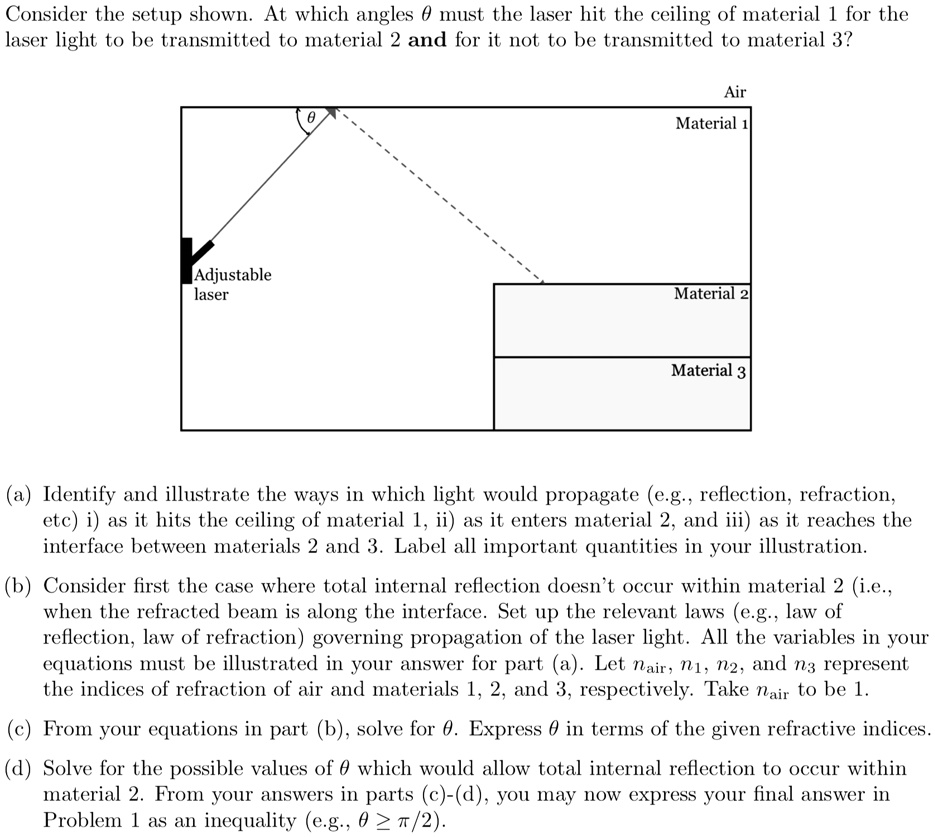
Consider the setup shown. At which angles $\theta$ must the laser hit the ceiling of material 1 for the laser light to be transmitted to material 2 and for it not to be transmitted to material 3? Adjustable laser $\theta$ Air Material 1 Material 2 Material 3 (a) Identify and illustrate the ways in which light would propagate (e.g., reflection, refraction, etc) i) as it hits the ceiling of material 1, ii) as it enters material 2, and iii) as it reaches the interface between materials 2 and 3. Label all important quantities in your illustration. (b) Consider first the case where total internal reflection doesn't occur within material 2 (i.e., when the refracted beam is along the interface. Set up the relevant laws (e.g., law of reflection, law of refraction) governing propagation of the laser light. All the variables in your equations must be illustrated in your answer for part (a). Let $n_{air}$, $n_1$, $n_2$, and $n_3$ represent the indices of refraction of air and materials 1, 2, and 3, respectively. Take $n_{air}$ to be 1. (c) From your equations in part (b), solve for $\theta$. Express $\theta$ in terms of the given refractive indices. (d) Solve for the possible values of $\theta$ which would allow total internal reflection to occur within material 2. From your answers in parts (c)-(d), you may now express your final answer in Problem 1 as an inequality (e.g., $\theta \ge \pi/2$).
View Answer
divider
BEST MATCH

Advance maths question Answer fairly 878. Define the concept of a Noetherian ring and its importance in commutative algebra.

View Answer
divider
BEST MATCH

the weight of the column of blood from the heart to the level where the pressure is measure

View Answer
divider
BEST MATCH

Who is the largest Cloud Service Provider ? Apple ? IBM ? AWS ? Google

View Answer
divider
BEST MATCH

The article "Softball Sliding Injuries" American Journal of Diseases of Children (1988) compares a sample of league games played with breakaway bases to another sample of league games played with stationary bases. For a sample of 1,250 games played with breakaway bases there were 20 sliding injuries. For a sample of 1,250 games played with stationary bases there were 90 sliding injuries. If you are interested in testing use of breakaway bases reduces sliding injuries, what is the null hypothesis? H0: Pbreakaway ? Pstationary H0: Pbreakaway ? Pstationary H0: Pbreakaway ? Pstationary None of the answers is correct.

View Answer
divider