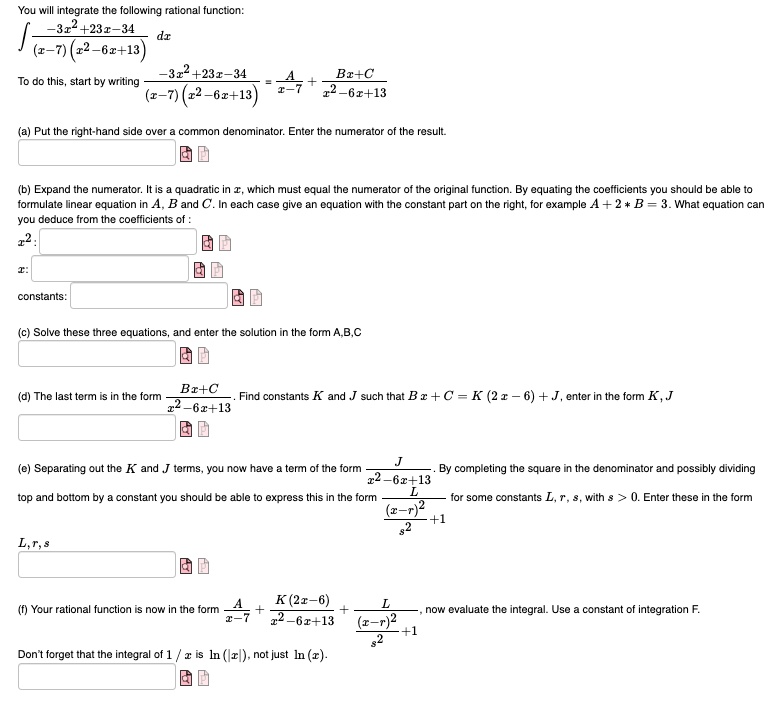
Texts: You will integrate the following rational function: ∫(32+2334)/(x-7)(x^2-6x+13) dx. To do this, start by writing x-7x^2-6x+13 as B+C/(x-7)(x^2-6x+13).
(a) Put the right-hand side over a common denominator. Enter the numerator of the result. .0
(b) Expand the numerator. It is a quadratic in x, which must equal the numerator of the original function. By equating the coefficients you should be able to formulate a linear equation in A, B, and C. In each case, give an equation with the constant part on the right, for example A + 2 * B = 3. What equation can you deduce from the coefficients of x?
(c) Solve these three equations and enter the solution in the form A.B.C.
Bx+C (a) The last term is in the form Bx+C. Find constants K and J such that B + C = K(2x-6) + J. Enter in the form K, J.
2-6x+13 00
J (e) Separating out the K and J terms, you now have a term of the form J/(x^2-6x+13). By completing the square in the denominator and possibly dividing (x^2-6x+13) top and bottom by a constant, you should be able to express this in the form (x-r)^2 +1/s^2 for some constants L, r, s, with s > 0. Enter these in the form (xr)^2 +1/s^2 L,r,s .0
A (f) Your rational function is now in the form A/(x-7) + K(2x-6)/(x-r)^2 +1/s^2. Now evaluate the integral. Use a constant of integration F.
2-6x+13 (x-r)^2 +1/s^2
Don't forget that the integral of 1/x is ln|x|, not just ln(x).