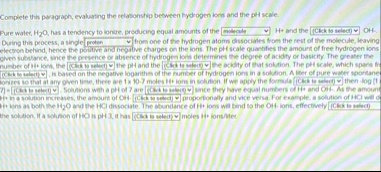
Complete this paragraph, evaluating the relationship between hydrogen ions and the pH scale.
Pure water, H$_2$O, has a tendency to ionize, producing equal amounts of the molecule H$^+$ and the (Click to select) OH$^-$.
During this process, a single proton from one of the hydrogen atoms dissociates from the rest of the molecule, leaving electron behind, hence the positive and negative charges on the ions. The pH scale quantifies the amount of free hydrogen ions given substance, since the presence or absence of hydrogen ions determines the degree of acidity or basicity. The greater the number of H$^+$ ions, the (Click to select) the pH and the (Click to select) the acidity of that solution. The pH scale, which spans fre (Click to select) is based on the negative logarithm of the number of hydrogen ions in a solution. A liter of pure water spontane ionizes so that at any given time, there are 1x 10$^{-7}$ moles H$^+$ ions in solution. If we apply the formula (Click to select) then -log [1 7=(Click to select) Solutions with a pH of 7 are (Click to select) since they have equal numbers of H$^+$ and OH$^-$. As the amount in a solution increases, the amount of OH- (Click to select) proportionally and vice versa. For example, a solution of HCl will d H$^+$ ions as both the H$_2$O and the HCl dissociate. The abundance of H$^+$ ions will bind to the OH- ions, effectively (Click to select) the solution. If a solution of HC is pH 3, it has (Click to select) moles H$^+$ ions/liter