Ace - AI Tutor
Ask Our Educators
Textbooks
My Library
Flashcards
Scribe - AI Notes
Notes & Exams
Download App
michelle hill

michelle h.

Divider

Questions asked

BEST MATCH

6. Obtain the transfer function of the following active filter. Determine the type of filter [ 20 points]

View Answer
divider
BEST MATCH

Which two statements are correct in a comparison of IPv4 and IPv6 packet headers? (Choose two.) The Time-to-Live field from IPv4 has been replaced by the Hop Limit field in IPv6. The Destination Address field is new in IPv6. The Source Address field name from IPV kept in IPV6. The Version field from IPv4 is not kept in IPv6. The Header Checksum field name from IPv4 is kept in IPv6.

View Answer
divider
BEST MATCH

In the electron transport chain, the oxygen that enters the cell becomes part of what molecule? ? NADPH ? glucose ? ATP ? water

View Answer
divider
BEST MATCH

Explain how to ensure end of life plans and advance care plans are understood and shared

View Answer
divider
BEST MATCH

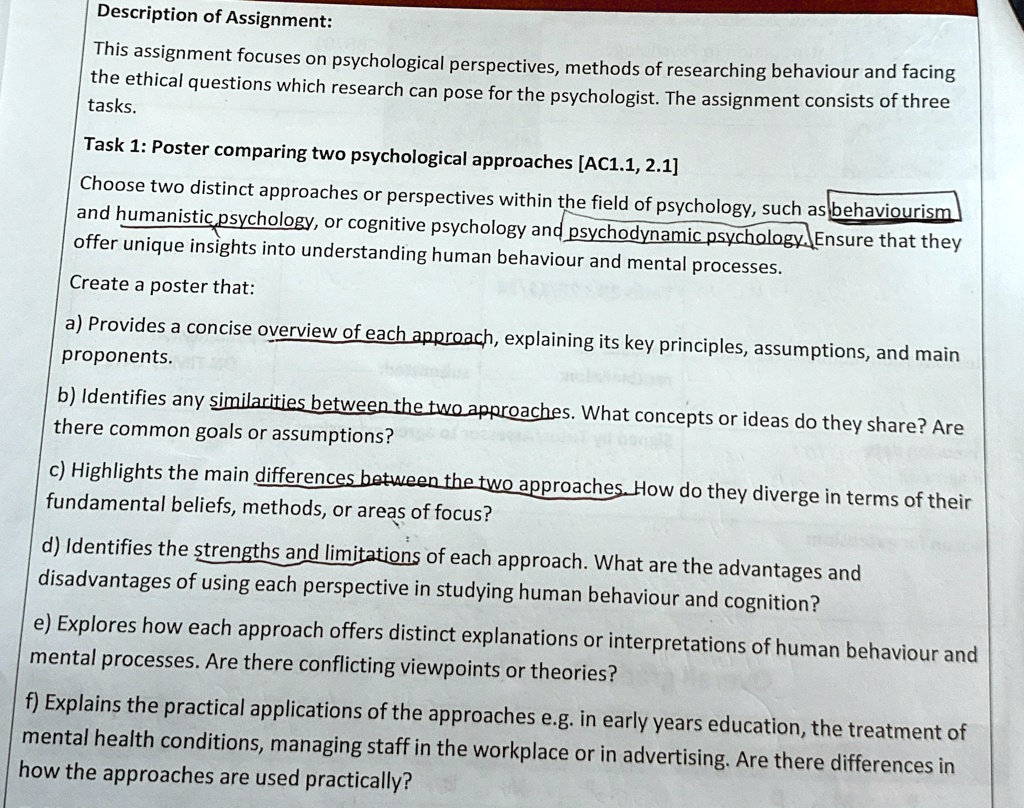
Description of Assignment: This assignment focuses on psychological perspectives, methods of researching behaviour and facing the ethical questions which research can pose for the psychologist. The assignment consists of three tasks. Task 1: Poster comparing two psychological approaches [AC1.1, 2.1] Choose two distinct approaches or perspectives within the field of psychology, such as behaviourism and humanistic psychology, or cognitive psychology and psychodynamic psychology. Ensure that they offer unique insights into understanding human behaviour and mental processes. Create a poster that: a) Provides a concise overview of each approach, explaining its key principles, assumptions, and main proponents. b) Identifies any similarities between the two approaches. What concepts or ideas do they share? Are there common goals or assumptions? c) Highlights the main differences between the two approaches. How do they diverge in terms of their fundamental beliefs, methods, or areas of focus? d) Identifies the strengths and limitations of each approach. What are the advantages and disadvantages of using each perspective in studying human behaviour and cognition? e) Explores how each approach offers distinct explanations or interpretations of human behaviour and mental processes. Are there conflicting viewpoints or theories? f) Explains the practical applications of the approaches e.g. in early years education, the treatment of mental health conditions, managing staff in the workplace or in advertising. Are there differences in how the approaches are used practically?
View Answer
divider
BEST MATCH

What does COUNTA () function do? a. Counts empty cells b. Counts cells having number c. Counts cells having alphabets d. Counts non-empty cells

View Answer
divider
BEST MATCH

These are the preparation questions for my next lesson in university. I need to search for answers online, but I would like to check if my answers (I got from research) is correct by getting a model answer from an expert. The text book I am using is Organic chemistry Structure and function seventh edition by Peter Vollhardt and Neil Schore Topic 12‐7.Oxymercuration‐demercuration (1) Selectivity of oxymercuration? (2) Advantage of oxymercuration over acid‐catalyzed hydration? Topic 12‐8.Hydroboration‐oxidation (1) Stereoselectivity of hydroboration: syn or anti? (2) Regioselectivity? (3) What is the transition state of hydroboration of alkene? (4) Mechanism of oxidation of alkyl borane? (5) As a result of hydroboration‐oxidation of alkene, selectivity of alkene is Markovnikov or anti‐Markovnikov? Topic 12‐9.Diazomethane, carbenes and cyclopropane synthesis (1) Structure and reactivity of carbene? (2) Stereoselectivity of cyclopropanation of alkene and diazomethane? (3) What are advantages of the Simmons‐Smith reagent over diazomethane?

View Answer
divider
BEST MATCH

SCENARIO 2: At a visit to the Exploratorium your students are talking about the colored shadows they saw. Three light bulbs of three different colors (red, green, and blue) were shining on a white wall. A pencil was held up and cast shadows. The wall, which was illuminated by all three bulbs, appears white, but there were three distinct shadows of the pencil. Each shadow was a different color. One was yellow, one magenta, and one was cyan #1 In scenario 2, we can see red light from the red bulb shining on the wall on the far left. Blue light from the blue bulb shines on the wall at the far right. At the center, around the hand, the part of the wall not in shadow appears white. Why?

View Answer
divider
BEST MATCH

6. A shopping cart is pushed through a store. The cart requires 40 N of force to move it. If the total distance the cart is pushed is 90 m, how much work is needed? a. 310 J b. 385 J c. 458 J d. none of the answers

View Answer
divider
BEST MATCH

6a. A 192g block is pressed against a spring of force constant 1.23kN/m until the block compresses the spring 10.7cm. The spring rests at the bottom of a ramp inclined at 55.0° to the horizontal. Using energy considerations, determine how far up the incline the block moves before it stops if there is no friction between the block and the ramp. 4.56 m 6b. How far up the incline does the block move before it stops if the coefficient of kinetic friction is 0.475? 6.73m A constant torque of 25.2Nm is applied to a grindstone whose moment of inertia is 0.110kg-m². Using energy principles, calculate the angular speed (in revolutions per second) after the grindstone has made 11.0 revolutions. (Neglect friction.) Do not enter units. 20.02

View Answer
divider