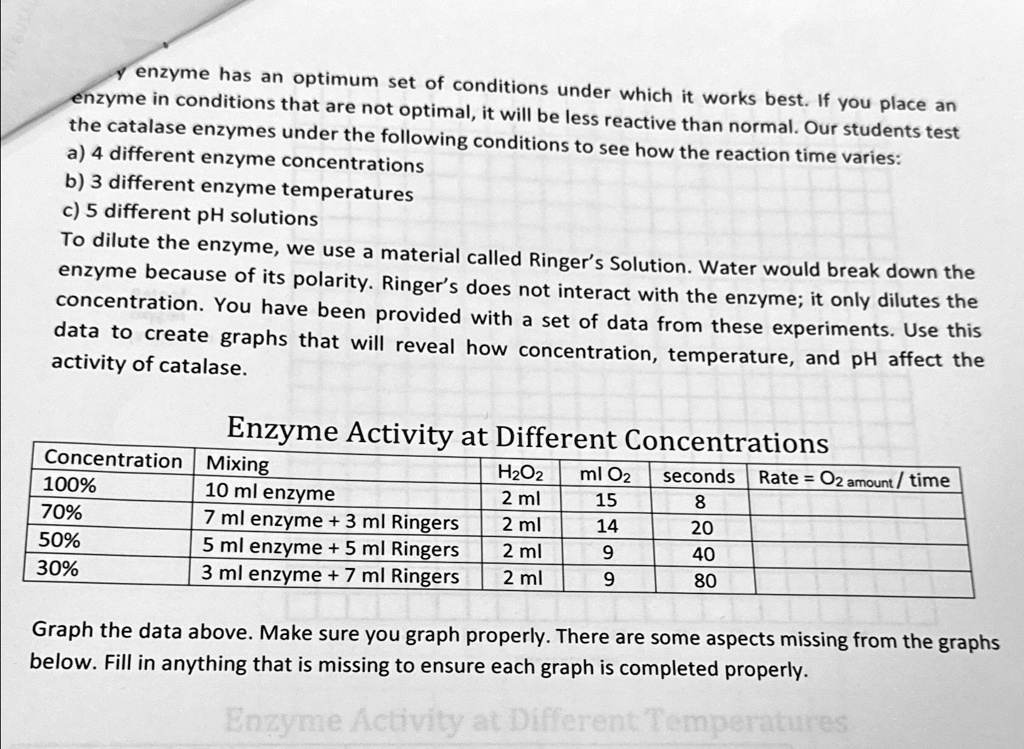
enzyme has an optimum set of conditions under which it works best. If you place an enzyme in conditions that are not optimal, it will be less reactive than normal. Our students test the catalase enzymes under the following conditions to see how the reaction time varies:
a) 4 different enzyme concentrations
b) 3 different enzyme temperatures
c) 5 different pH solutions
To dilute the enzyme, we use a material called Ringer's Solution. Water would break down the enzyme because of its polarity. Ringer's does not interact with the enzyme; it only dilutes the concentration. You have been provided with a set of data from these experiments. Use this data to create graphs that will reveal how concentration, temperature, and pH affect the activity of catalase.
Enzyme Activity at Different Concentrations
[table
[Concentration, Mixing, H2O2 ml, O2 ml, seconds, Rate O2 amount / time],
[100%, 10 ml enzyme, 2 ml, 15, 8],
[70%, 7 ml enzyme + 3 ml Ringers, 2 ml, 14, 20],
[50%, 5 ml enzyme + 5 ml Ringers, 2 ml, 9, 40],
[30%, 3 ml enzyme + 7 ml Ringers, 2 ml, 9, 80]
]
Graph the data above. Make sure you graph properly. There are some aspects missing from the graphs below. Fill in anything that is missing to ensure each graph is completed properly.
Enzyme Activity at Different Temperatures