Questions asked
An electroscope is negatively charged, and its leaves diverge. What would happen to the leaves (and why) if you touched the bulb with a) your finger and b) a glass rod that has been rubbed with silk?
Self complementary DNA is composed of two identical strands. This type of DNA is also called palindromic DNA. An example of self complementary DNA is TGCGCATGC. We designate this palindromic duplex as $S_2$ and its melting equilibrium is $S_2 \rightleftharpoons 2S$. In the case of palindromic DNA the total concentration of single strand is $C_T$. If the fraction of single strand that is in duplex form at equilibrium is $f$, then the concentration of single strand at equilibrium is $[S] = C_T(1-f)$ and the concentration of duplex DNA at equilibrium is $[S_2] = \frac{C_T f}{2}$. The equilibrium constant for melting of this DNA palindrome is $K = \frac{[S]^2}{[S_2]} = \frac{C_T(1-f)^2}{f/2}$. Part A Suppose the concentrations of single strand at equilibrium are $[S] = [S'] = C_T(1-f)$ and the duplex concentration is $[S_2] = \frac{C_T f}{2}$ and $f$ are defined exactly as above. Select the proper expression for the equilibrium constant for the melting of designated palindromic DNA. $K = \frac{C_T(1-f)^2}{f/2}$ Part B Suppose 0.100grams of a DNA duplex are dissolved in 100 ml of water. Assume the molar mass of the DNA duplex is 7800grams. When the duplex $5' \cdots 5'$ reaches equilibrium with single stranded forms $S$ and $S'$ at T=310K, 90% of the DNA is in duplex form. Calculate the equilibrium constant for DNA melting at T=310K. Part C The melting point is defined as the temperature at which half the strands have formed duplex ($f = 0.50$). Assume the DNA in Part B has a melting point of T=320K. Calculate the equilibrium constant at T=320K. Part D Using the results from Parts B and C, calculate the standard molar enthalpy of melting of the DNA. You may assume $\Delta H^\circ$ is constant between T=310K and T=320K. $\Delta H^\circ$ - Value Units
1 1 point Which of the following steps in an extract-transform-load (ETL) process creates an updated version of a data warehouse? Load Extract Transform Autorun
• A circuit is constructed of an AC power generator and a capacitor. The capacitor has a capacitance of 1.50 µF and the rms voltage is 25.0V. What is the rms current in the circuit when the frequency of the generator is a) 100 Hz b) 5,000 Hz
8. Once you've taken a bite of pizza, describe the mechanical and chemical digestive processes that occur in the oral cavity.
How long will it take for a $1000 investment to grow to $1500 at an annual rate of 15%, compounded monthly? Assume that no withdrawals are made. Do not round any intermediate computations, and round your answer to the nearest hundredth. If necessary, refer to the list of financial formulas.
Using $\lim_{\theta \to 0} \frac{\sin \theta}{\theta} = 1$, find the limit. $\lim_{y \to 0} \frac{9 \sin(\sin 3y)}{5 \sin 3y}$ $\lim_{y \to 0} \frac{9 \sin(\sin 3y)}{5 \sin 3y} = \boxed{}$ (Simplify your answer.)
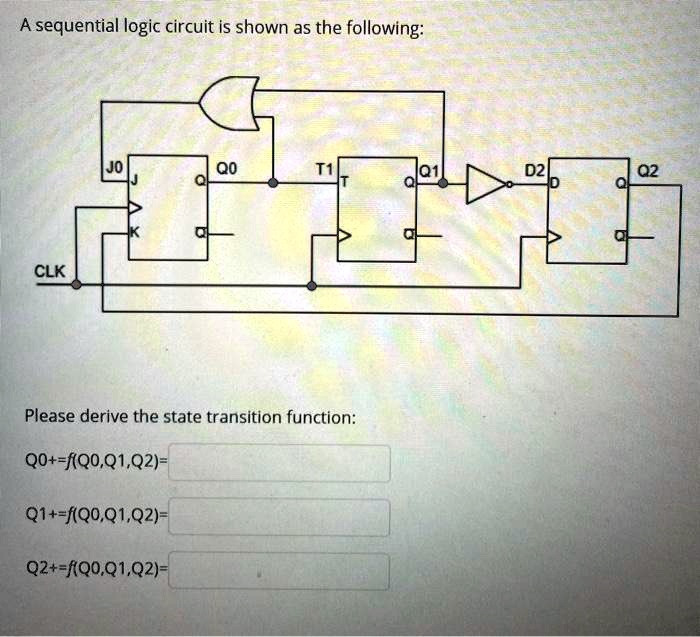
A sequential logic circuit is shown as the following: JO QO 11 ?1 D2 Q2 CLK Please derive the state transition function: Q0+=f(Q0,Q1,Q2) Q1+=f(Q0,Q1,Q2) Q2+=f(Q0,Q1,Q2)
6. An industrial load is modeled as a series combination of an inductor and a resistance as shown below. Calculate the value of a capacitor C across the series combination so that the net impedance is resistive at a frequency of 2 kHz. a b 10? C 5mH 7. The figure below shows a parallel combination of an inductance resistance. If it is desired to connect a capacitor in series with the parallel combination such that the net impedance is resistive at 10 MHz, what is the required value of C? a b C 300? 20?H
The single phase half bridge inverter has RL-load of R = 20 \Omega, L= 40 mH, and the dc input voltage is (120 V). Considering the harmonics order until n=7, determine: (a) The rms output voltage at the fundamental frequency Vo1; (b) The output power Po1 at the fundamental frequency; (c) The average, and peak currents of each transistor (switch); (d) The total harmonics distortion THD; (f) The distortion factor DF; and (g) the harmonic factor and distortion factor of the lowest order harmonic.