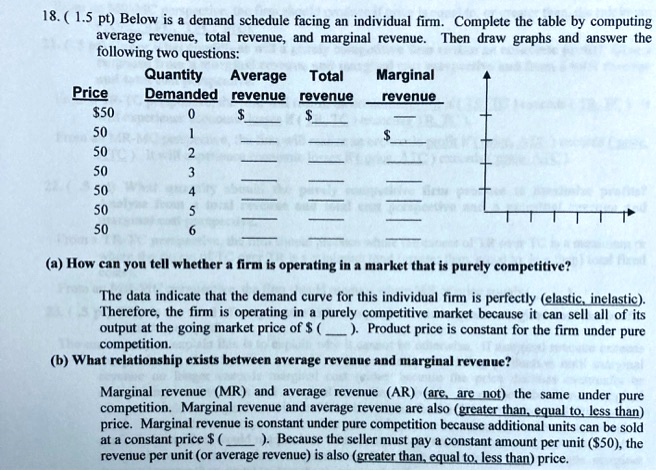
18. (1.5 pt) Below is a demand schedule facing an individual firm. Complete the table by computing
average revenue, total revenue, and marginal revenue. Then draw graphs and answer the
following two questions:
Quantity Average Total Marginal
Demanded revenue revenue
Price
revenue
$50
0
$
$
50
1
50
2
50
3
50
4
50
5
50
6
$
(a) How can you tell whether a firm is operating in a market that is purely competitive?
The data indicate that the demand curve for this individual firm is perfectly (elastic, inelastic).
Therefore, the firm is operating in a purely competitive market because it can sell all of its
output at the going market price of $ ( ). Product price is constant for the firm under pure
competition.
(b) What relationship exists between average revenue and marginal revenue?
Marginal revenue (MR) and average revenue (AR) (are, are not) the same under pure
competition. Marginal revenue and average revenue are also (greater than, equal to, less than)
price. Marginal revenue is constant under pure competition because additional units can be sold
at a constant price $ ( ). Because the seller must pay a constant amount per unit ($50), the
revenue per unit (or average revenue) is also (greater than, equal to, less than) price.