Please explain the steps.
Two sinusoidal signals are defined as:
xr = 2sin(16r)
xz = 4cos(2x10r)
y2 = x1.xrxr + xr
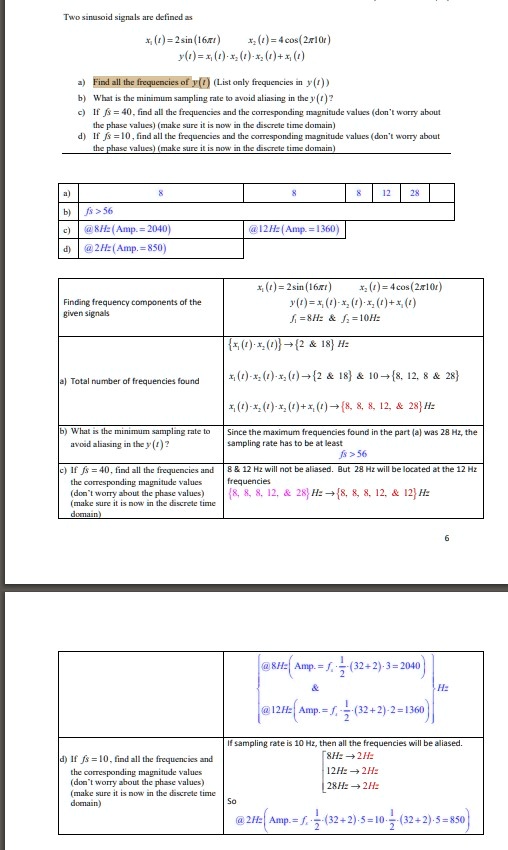
a) Find all the frequencies of y (List only frequencies in y(r)).
b) What is the minimum sampling rate to avoid aliasing in y()?
c) If fs = 40, find all the frequencies and the corresponding magnitude values (don't worry about the phase values) (make sure it is now in the discrete time domain).
d) If fs = 10, find all the frequencies and the corresponding magnitude values (don't worry about the phase values) (make sure it is now in the discrete time domain).
8
8
b) fs > 56.
@8Hz (Amp. = 2040)
@2Hz (Amp. = 850)
@12Hz (Amp. = 1360)
xr = 2sin(16r)
xr = 4cos(210r)
yx = xxrxx + x
f = 8Hz
f = 10Hz
Finding frequency components of the given signals:
{xx} - {2&18}Hz
a) Total number of frequencies found:
xrxxr {2&18} & 10 {8, 12, 8&28}
xxxr + x + {8, 8, 8, 12, &28}Hz
b) What is the minimum sampling rate to avoid aliasing in y()?
Since the maximum frequencies found in part (a) was 28Hz, the sampling rate has to be at least fs > 56.
c) If fs = 40, find all the frequencies and 8 & 12Hz will not be aliased. But 28Hz will be located at 12Hz.
The corresponding magnitude values frequencies (don't worry about the phase values):
{8, 8, 8, 12, &28}Hz
{8, 8, 8, 12, &12}Hz (make sure it is now in the discrete time domain)
@8Hz (Amp. = 2040)
@12Hz (Amp. = 1360)
If the sampling rate is 10Hz, then all the frequencies will be aliased.
d) If fs = 10, find all the frequencies and 8Hz, 2Hz, and 12Hz will not be aliased.
The corresponding magnitude values:
8Hz, 2Hz, 12Hz, 28Hz (make sure it is now in the discrete time domain)
@2Hz (Amp. = 1032+25 = 850)