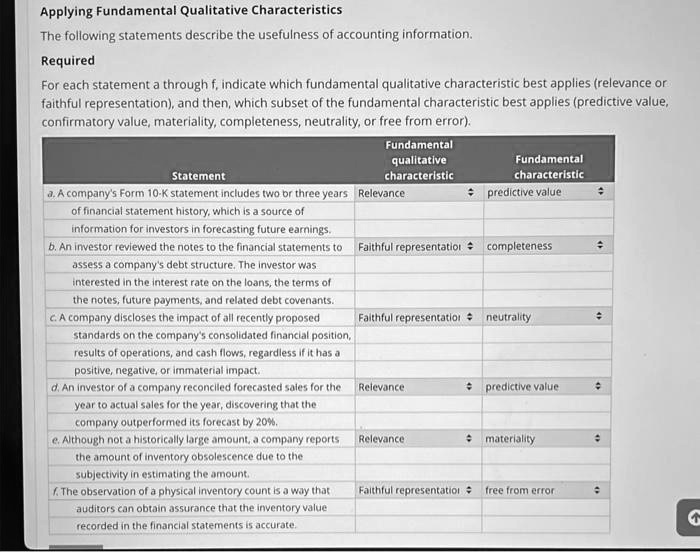
Applying Fundamental Qualitative Characteristics
The following statements describe the usefulness of accounting information.
Required
For each statement a through f, indicate which fundamental qualitative characteristic best applies (relevance or
faithful representation), and then, which subset of the fundamental characteristic best applies (predictive value,
confirmatory value, materiality, completeness, neutrality, or free from error).
Statement
Fundamental
qualitative
characteristic
Fundamental
characteristic
a. A company's Form 10-K statement includes two or three years Relevance
predictive value
of financial statement history, which is a source of
information for investors in forecasting future earnings.
b. An investor reviewed the notes to the financial statements to
assess a company's debt structure. The investor was
interested in the interest rate on the loans, the terms of
the notes, future payments, and related debt covenants.
c. A company discloses the impact of all recently proposed
standards on the company's consolidated financial position,
results of operations, and cash flows, regardless if it has a
positive, negative, or immaterial impact.
d. An investor of a company reconciled forecasted sales for the
year to actual sales for the year, discovering that the
company outperformed its forecast by 20%.
e. Although not a historically large amount, a company reports
the amount of inventory obsolescence due to the
subjectivity in estimating the amount.
f. The observation of a physical inventory count is a way that
auditors can obtain assurance that the inventory value
recorded in the financial statements is accurate.
Faithful representation completeness
Faithful representation neutrality
Relevance
predictive value
Relevance
materiality
Faithful representation free from error