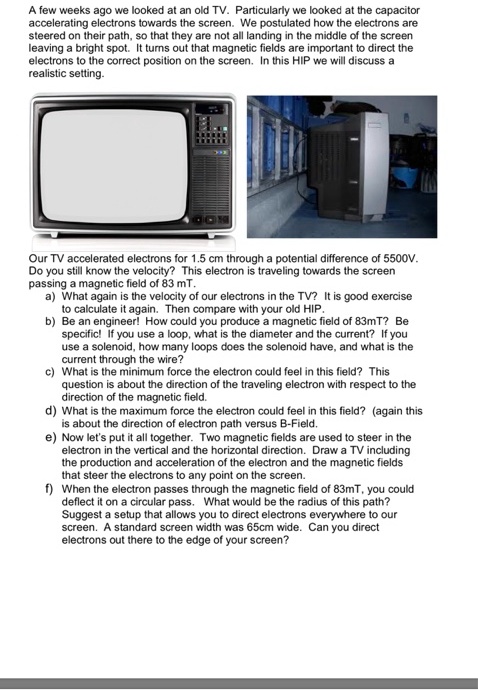
A few weeks ago we looked at an old TV. Particularly we looked at the capacitor
accelerating electrons towards the screen. We postulated how the electrons are
steered on their path, so that they are not all landing in the middle of the screen
leaving a bright spot. It turns out that magnetic fields are important to direct the
electron to the correct position on the screen. In this HIP we will discuss a
realistic setting.
Our TV accelerated electrons for 1.5 cm through a potential difference of 5500V.
Do you still know the velocity? This electron is traveling towards the screen
passing a magnetic field of 83 mT.
a) What again is the velocity of our electrons in the TV? It is good exercise
to calculate it again. Then compare with your old HIP.
b) Be an engineer! How could you produce a magnetic field of 83mT? Be
specific! If you use a loop, what is the diameter and the current? If you
use a solenoid, how many loops does the solenoid have, and what is the
current through the wire?
c) What is the minimum force the electron could feel in this field? This
question is about the direction of the traveling electron with respect to the
direction of the magnetic field.
d) What is the maximum force the electron could feel in this field? (again this
is about the direction of electron path versus B-Field.
e) Now let's put it all together. Two magnetic fields are used to steer in the
electron in the vertical and the horizontal direction. Draw a TV including
the production and acceleration of the electron and the magnetic fields
that steer the electrons to any point on the screen.
f) When the electron passes through the magnetic field of 83mT, you could
deflect it on a circular pass. What would be the radius of this path?
Suggest a setup that allows you to direct electrons everywhere to our
screen. A standard screen width was 65cm wide. Can you direct
electrons out there to the edge of your screen?